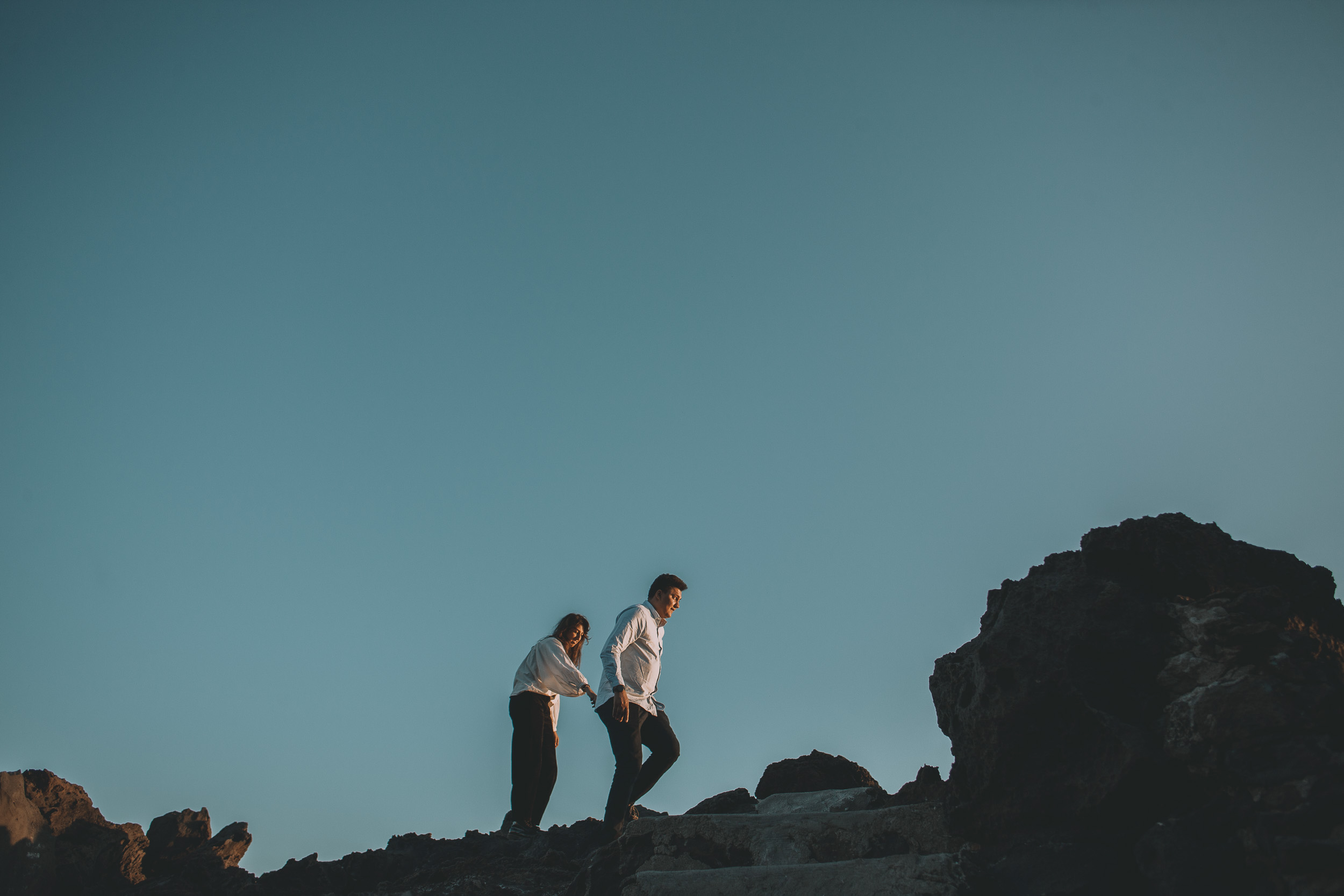
Planning guide
What to wear on Madeira.
Everything I tell clients the week before. Colour, fabric, layers, shoes, timing.
If you read nothing else
Wear something you already love. Light fabric, one calm colour, shoes you can walk in. Bring a layer. The rest is my job.
Below is the detail, with frames from sessions I shot here so you can see how each choice looks on the ground. Skip to what you need. Write on WhatsApp if something is missing.
01
Colour.
Most people stand in front of a suitcase the night before and try to solve this alone. You don't have to. Here is how colour behaves on this island, and what happened when clients made each choice.
If you want one line
Wear a big, quiet colour you already own. Cream, oat, soft denim, dove grey. Add one warm thing small enough to hold in your hand: a scarf, a lipstick, the tan edge of a shoe. Stop there.
If you want the logic
Keep reading. The background changes three times on Madeira.
Evening light
By six in the evening the light is gold.
Cream warms up. Skin warms up. Rust goes deeper. A white shirt reads as honey. Cool blues flatten out. Pure black holds no detail at that hour.
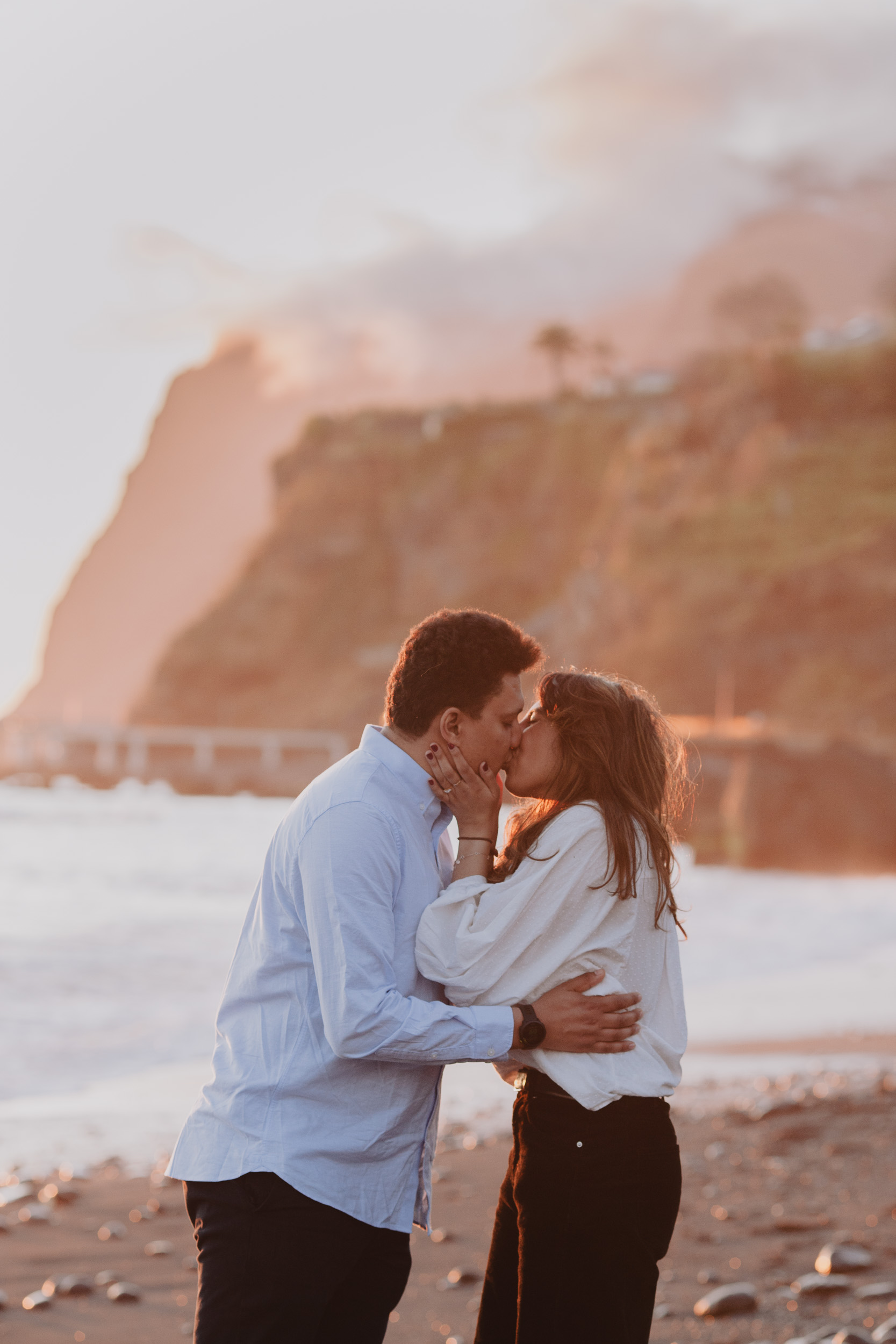
Pale blue and cream at Praia Formosa, ninety minutes before sunset.
Where we're standing
Three backgrounds.
Black sand, forest fog, old town. The same dress can be the best or the flattest thing in the frame depending on which one you're in.
Black sand and basalt
What to wear on black sand.
At Seixal and Praia Formosa the ground is dark and the rock behind you is darker. Anything pale cuts straight out of it: white, cream, oat, pale grey, soft blue.
This is the one place on the island where plain white is the strongest thing you can wear. No pattern needed.
Dark clothing still works here, as long as one person is light. Two dark outfits on black sand merge into one shape.
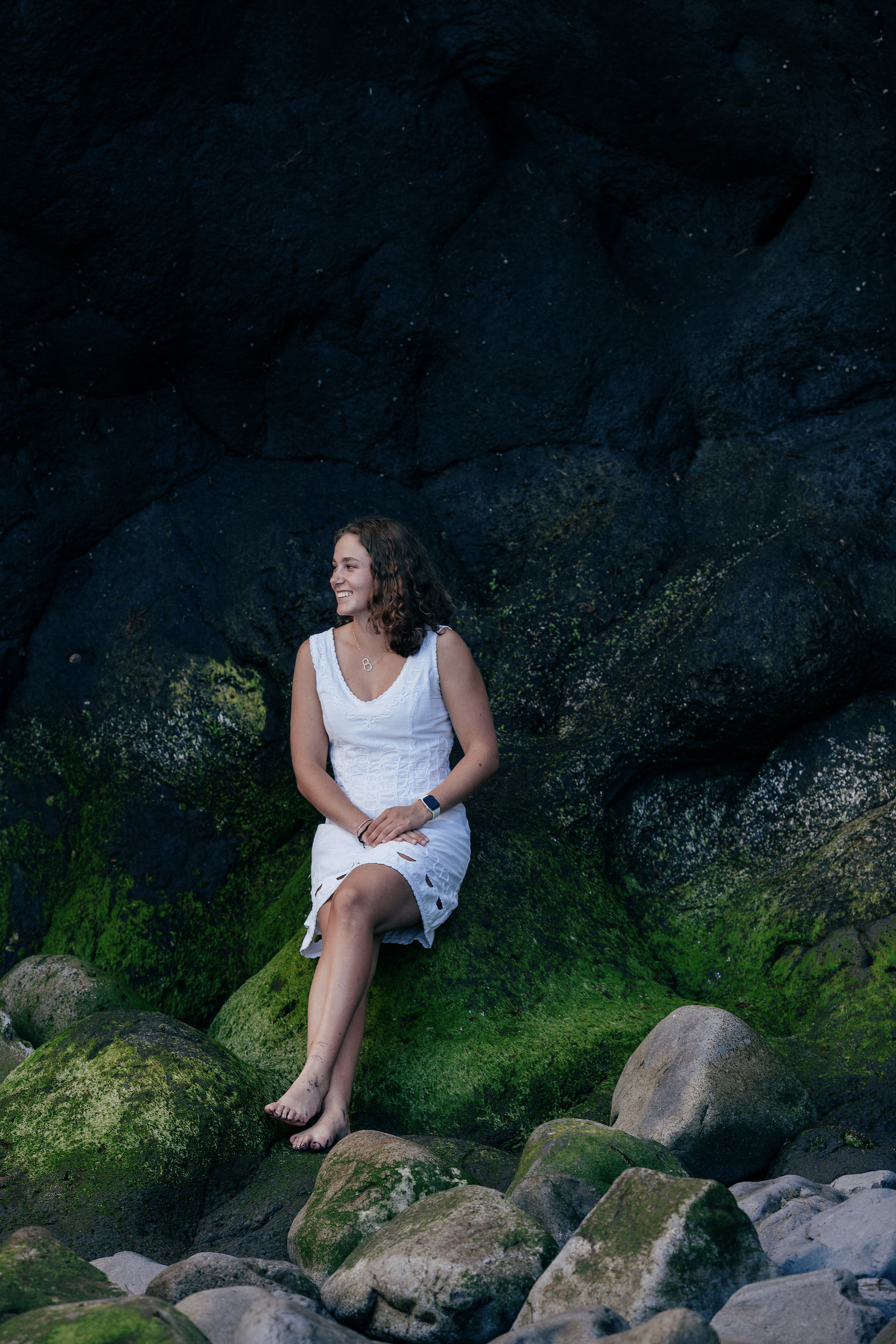
White cotton on wet basalt at Seixal. Nothing else in the frame is light.
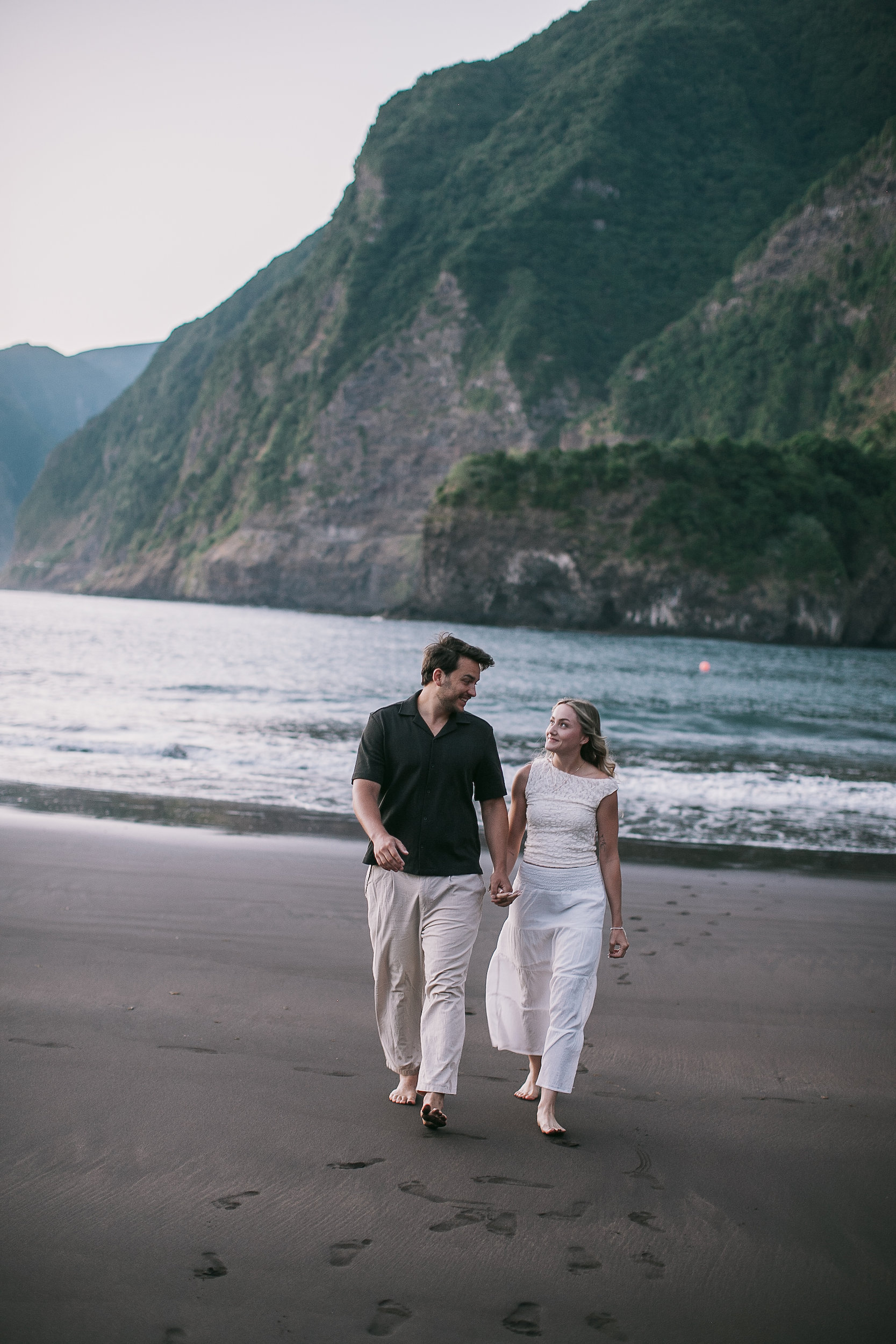
Same beach. One dark shape, one light shape, and they read as a pair.
Fog at Fanal
What to wear in the fog at Fanal.
On a foggy morning at Fanal the background is flat pale grey. The old laurels are the only dark thing in it.
Two things work up there. Pale fabric, which sinks into the fog and lets the trunks frame you. Or a deep colour, which turns you into the second dark shape next to the tree.
What goes quiet is mid-grey and mid-beige. They sit at the tone the fog sits at, and the frame loses its edges.
Fanal is also wet. Whatever you wear there will get damp at the hem.
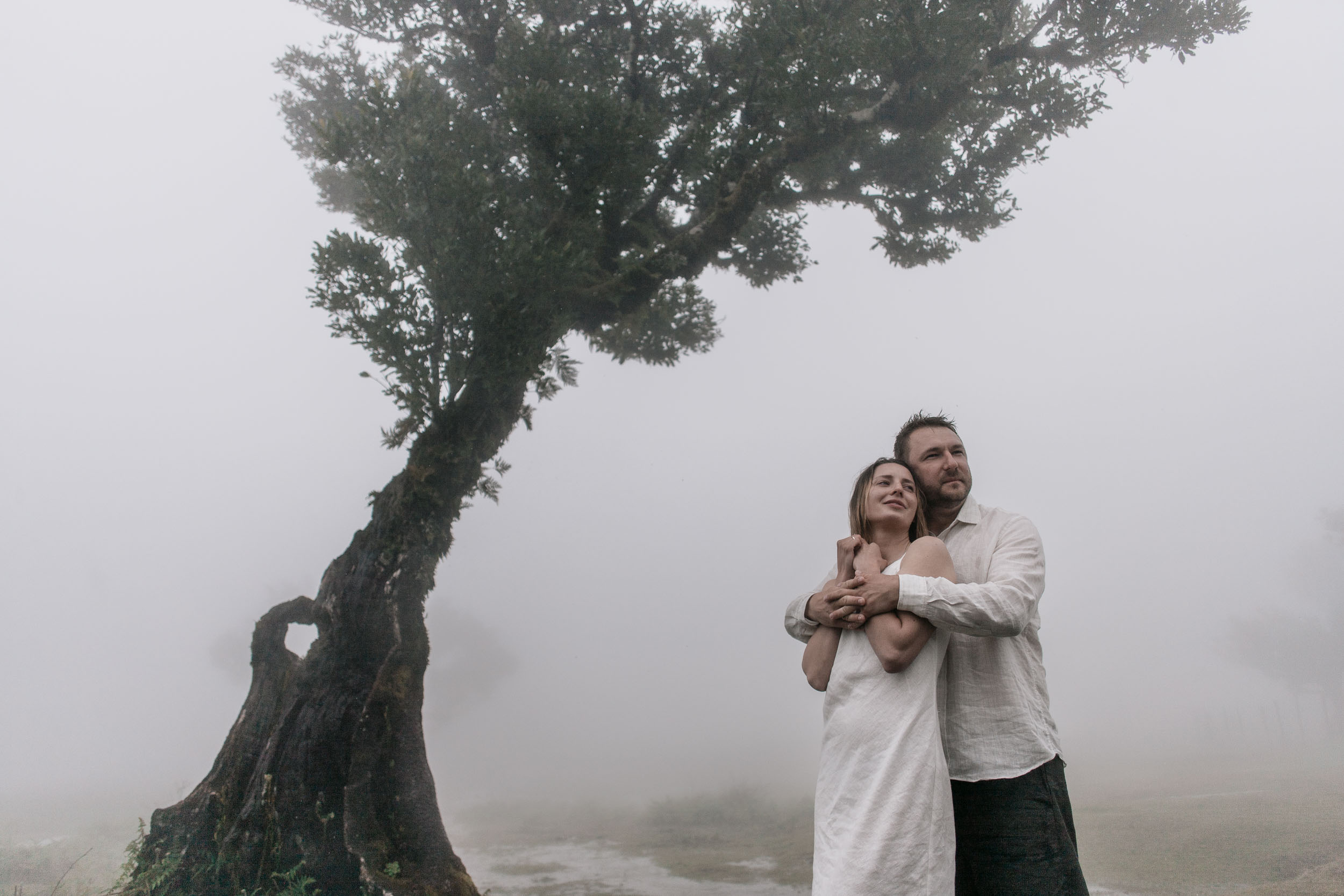
White linen in Fanal fog, May.
Funchal old town
What to wear in Funchal old town.
White walls, red roof tiles, black and white calçada underfoot, painted doors, market crates. The background is busy before you arrive.
Structured and plain beats flowing and printed here. A blazer, a clean shirt, a straight trouser.
Full black is fine in town. Light there is flat and filtered by the narrow streets, so black keeps its detail.
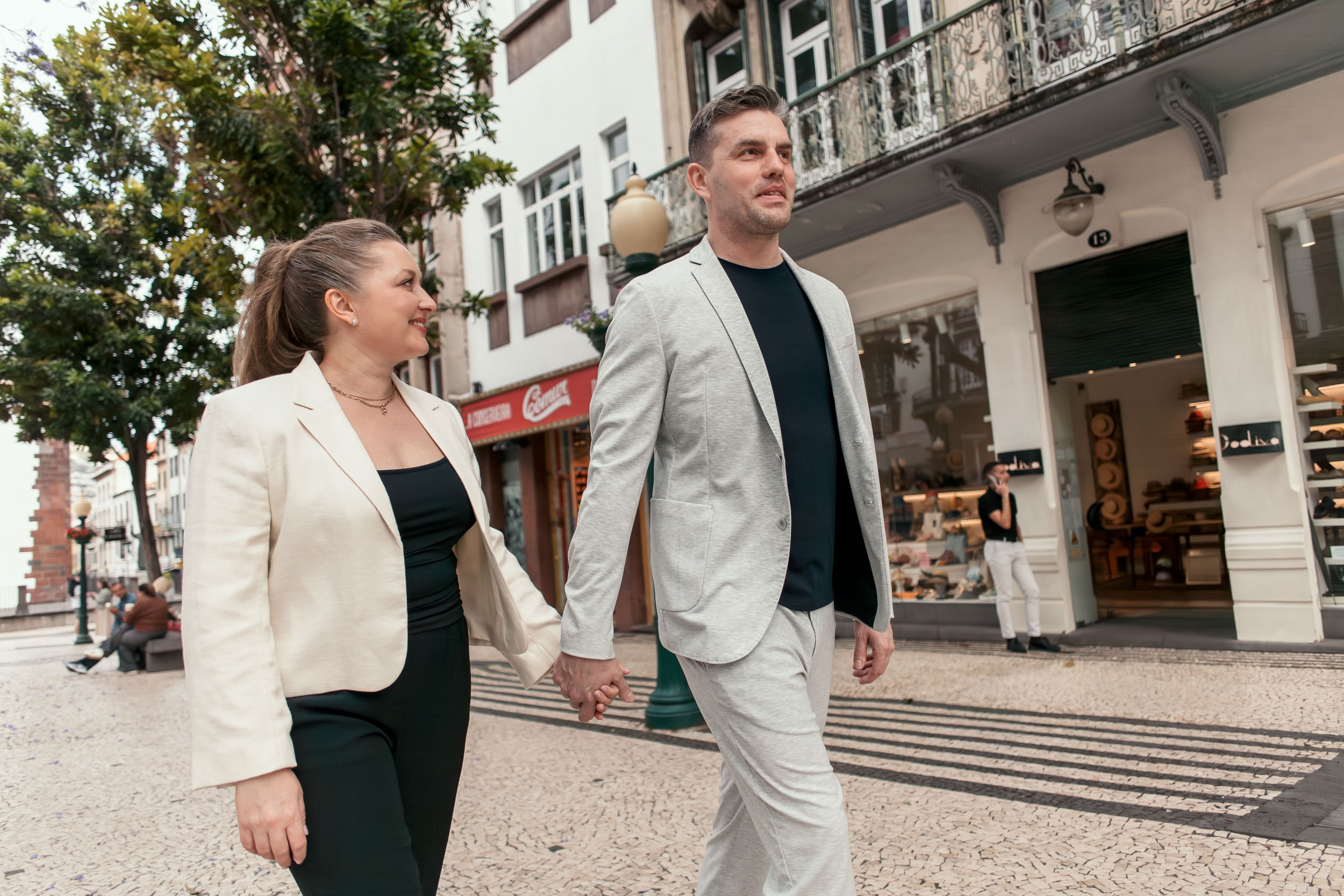
Cream blazer, black trousers, grey suit. Structure instead of print, on an old town street.
One rule, three parts
Sixty, thirty, ten.
The big, calm thing. A linen dress, cream trousers, a long skirt. It covers most of you.
A layer or a contrast. Denim jacket, pale cardigan, a skirt under a top. Different from the base but still in the same family.
One small warm thing. A scarf, your lipstick, the tan edge of a shoe. Ten percent of the frame is all the colour you need to add.
Against green laurel or dark volcanic stone, the accent that lifts a frame is warm. Terracotta, rust, burnt amber, mustard. The landscape here runs cool and green.
A palette that always works here
Four colours. Mix them how you like.
Cream
The warm white that lives everywhere. Forest, stone, sand, sea.
Oat
Warmer than cream, quieter than tan. Linen in the sun looks like this.
Washed denim
The blue of an overcast ocean. Sits next to anything without a fight.
Terracotta
The ten-percent warm accent. One of these in the frame. Never two.
Or pick another set
Three palettes built from different corners of the island. Pick one and dress to it.
Morning at Fanal
Fog between old trees, damp moss, a dry leaf on the ground.
Fog
Sage
Bark
Ochre
North coast
Bleached shell, the sea before a storm, wet basalt, a flash of copper.
Shell
Tide
Basalt
Copper
Funchal at dusk
Old town walls, warm lamps, the last sun on cobblestone.
Sand
Stone
Bark
Rust
Same rule in each: three quiet tones, one warm accent. Pick the set that fits where we're shooting.
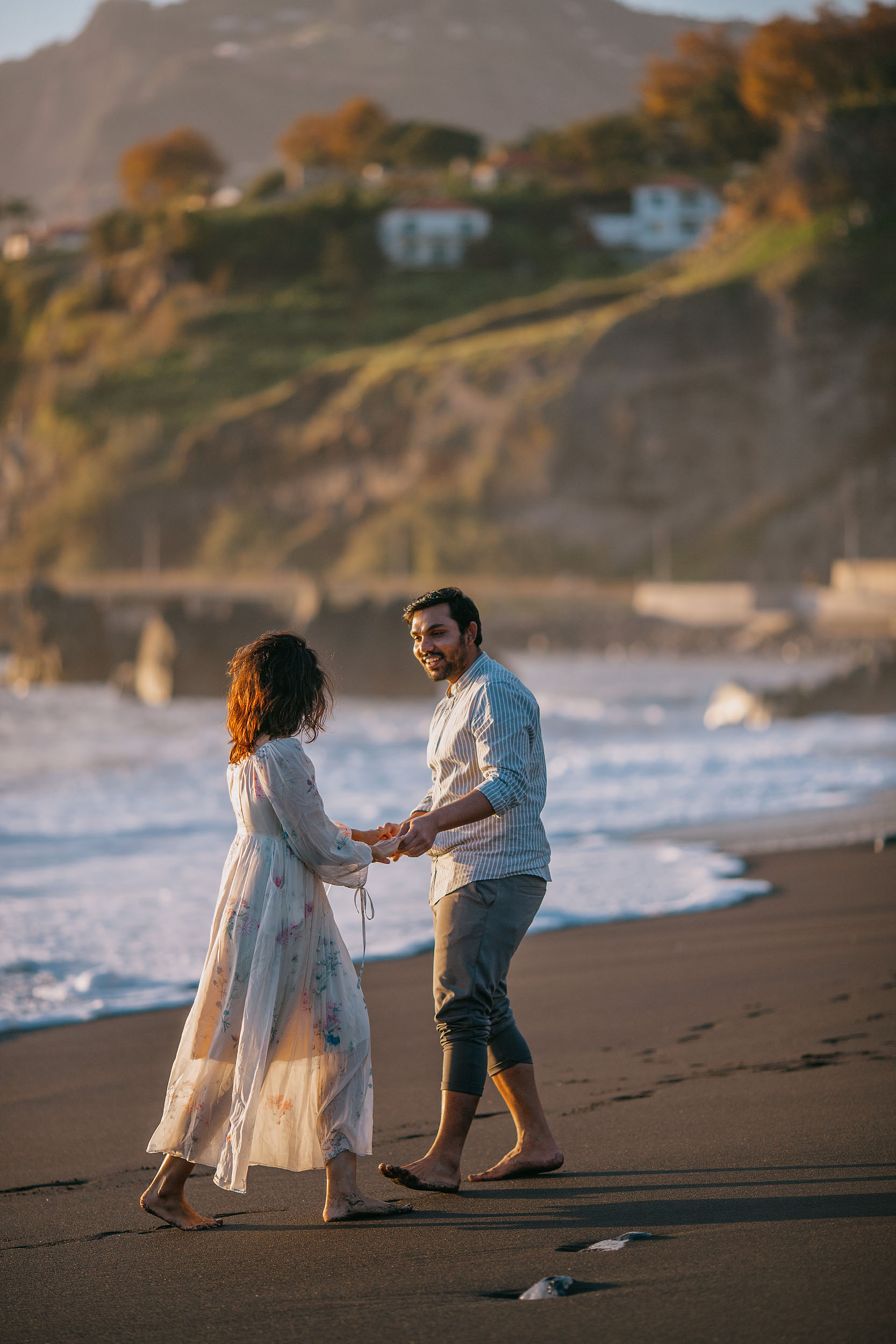
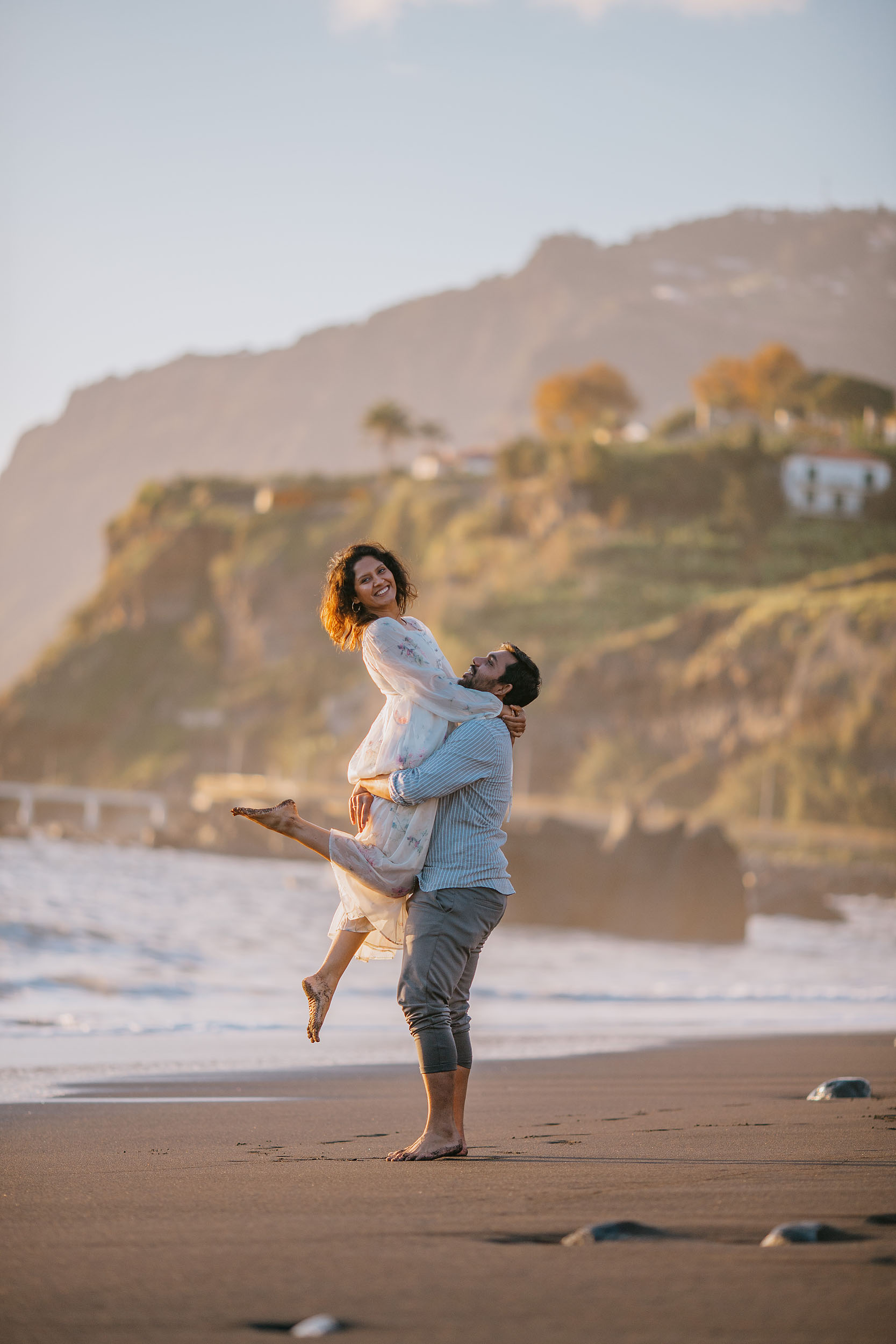
One session, two frames. Cream dress, denim shirt. The sunset light itself is the ten percent.
One more thing
If you want the bold piece, wear it.
A red dress. A rust linen suit. Something you bought for this trip because it made you feel like yourself. Bring it. There is one condition: it stays the only strong colour in the frame. Everyone else holds neutrals.
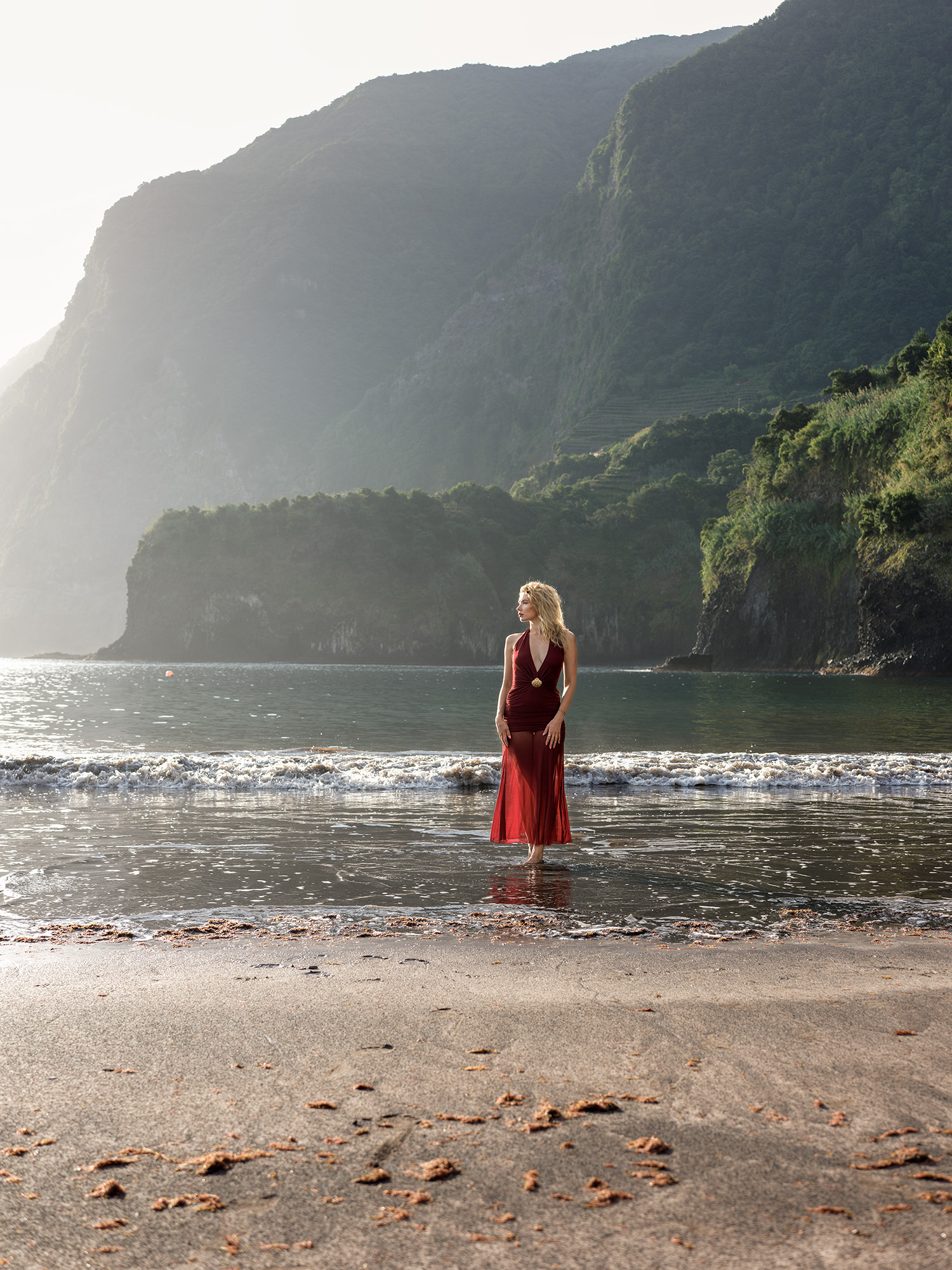
One red dress, green cliffs, black sand at Seixal.
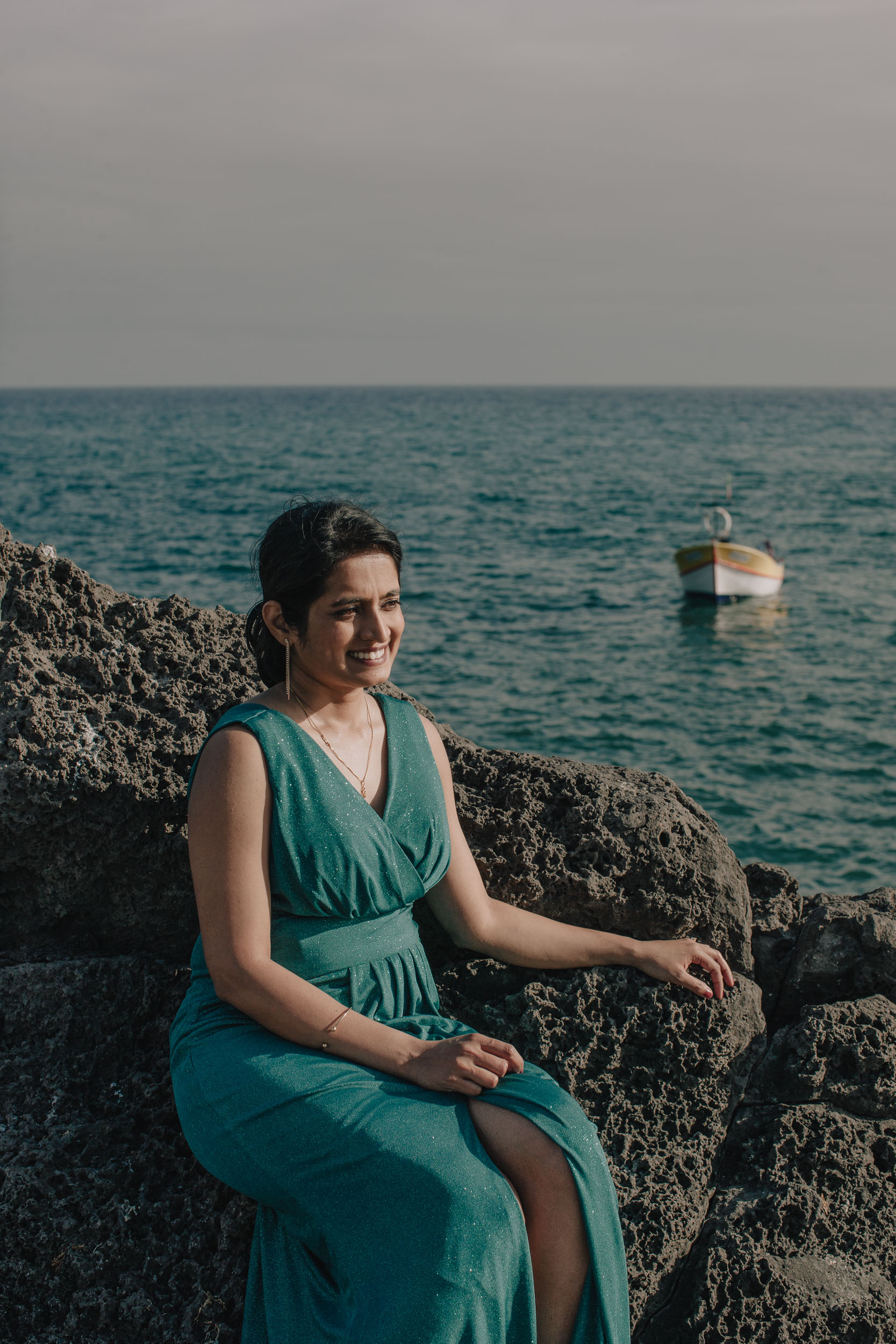
Teal on grey basalt at Câmara de Lobos. Same idea, different colour.
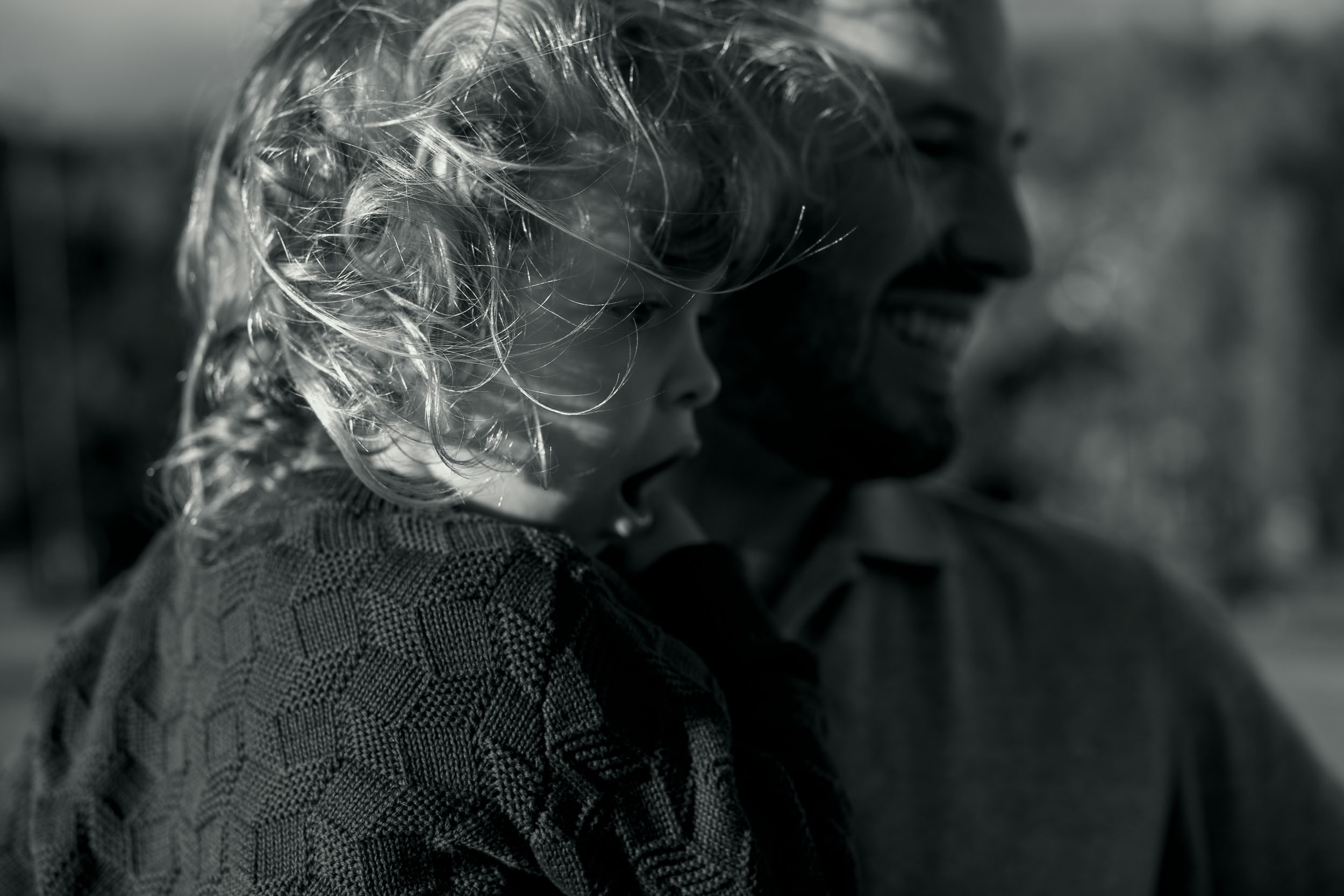
Wear what you've already worn a hundred times.
02
Fabric and shape.
Fabric that moves.
Chiffon, light cotton, linen, jersey. A long skirt, a wide sleeve, a loose shirt. The breeze on the coast is close to constant.
Half of my favourite frames from beach sessions come from a hem going up at the right second.
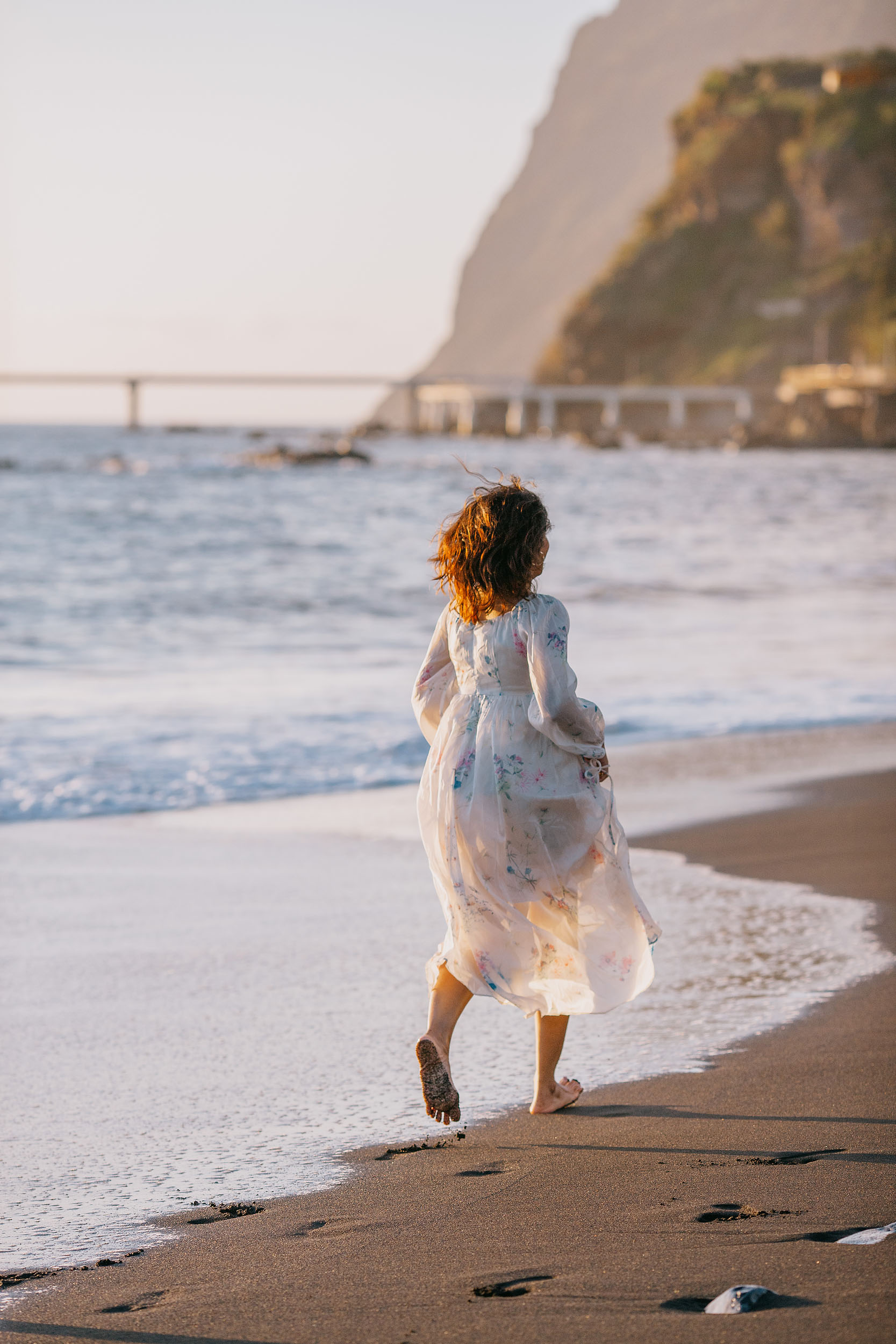
Cream chiffon at Praia Formosa in December. She ran.
Movement works without wind too.
Inland there is often no breeze at all. Inside the laurel forest the air stands still, and a hem only moves if you move it.
I ask people to turn, to walk fast, to be lifted. The same long skirt that the coast fills with wind will do the same thing from a turn, and it is the reason I suggest one loose piece even for a mountain session.
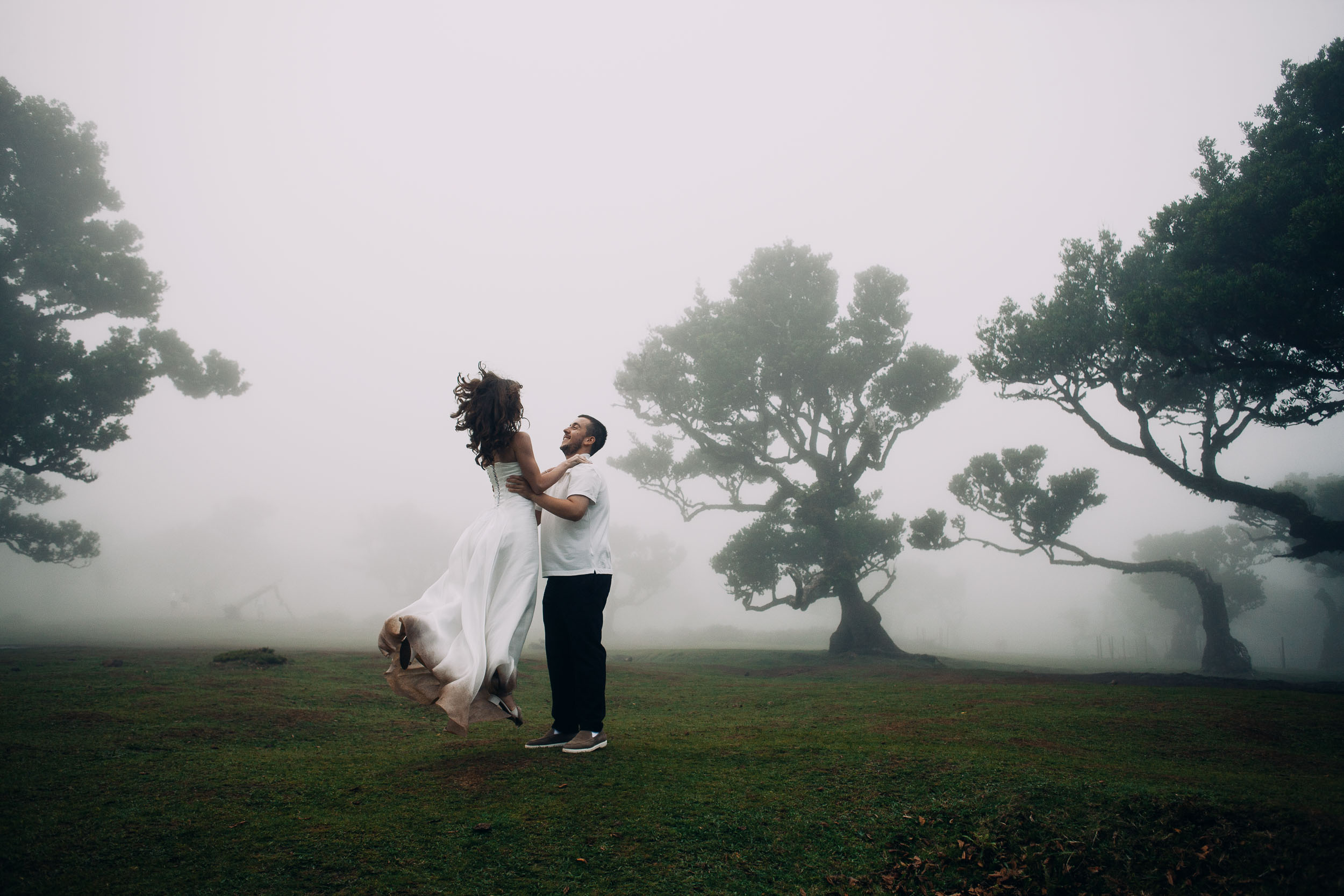
Fanal in September. No wind at all up there that evening, so the movement came from him.
A long light hem and wet ground.
Fanal and the high viewpoints hold water in the grass from the day before. A long pale dress picks that up inside the first ten minutes.
There are two ways to handle it. Accept it, which is what I recommend, because the alternative is standing still and that makes worse photographs than a stained hem does. Or bring the long dress for the coast half of the session and something shorter for the forest.
What does not work is deciding halfway through that it matters. The frames after that moment all show it.
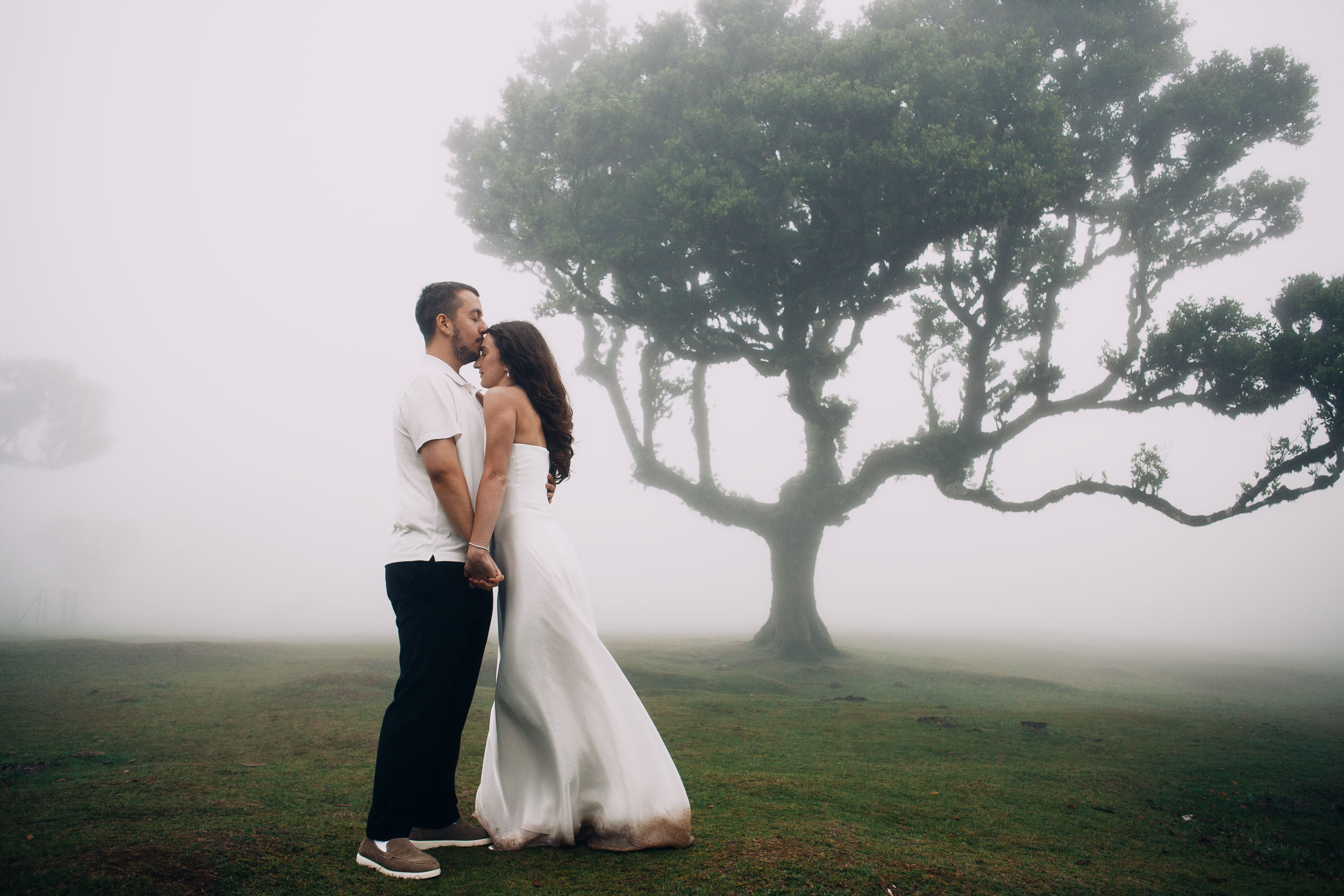
Ten minutes into a September session at Fanal. She noticed once and then stopped caring.
Fabric that holds still.
Stiff cotton, heavy denim, a fitted blazer, anything tailored close. None of it is wrong. It holds a clean line, and in the old town a clean line is what you want.
Those frames will be about the two of you and the street, with no movement in the cloth.
Try it at home first.
In a session you sit on wet rock, walk over loose stones, get lifted, and turn into the wind. Before you pack it, put the outfit on and do three things: sit down, raise both arms, walk fast.
If any of that made you adjust something, you'll spend the whole hour adjusting it. I can see that in the pictures afterwards.
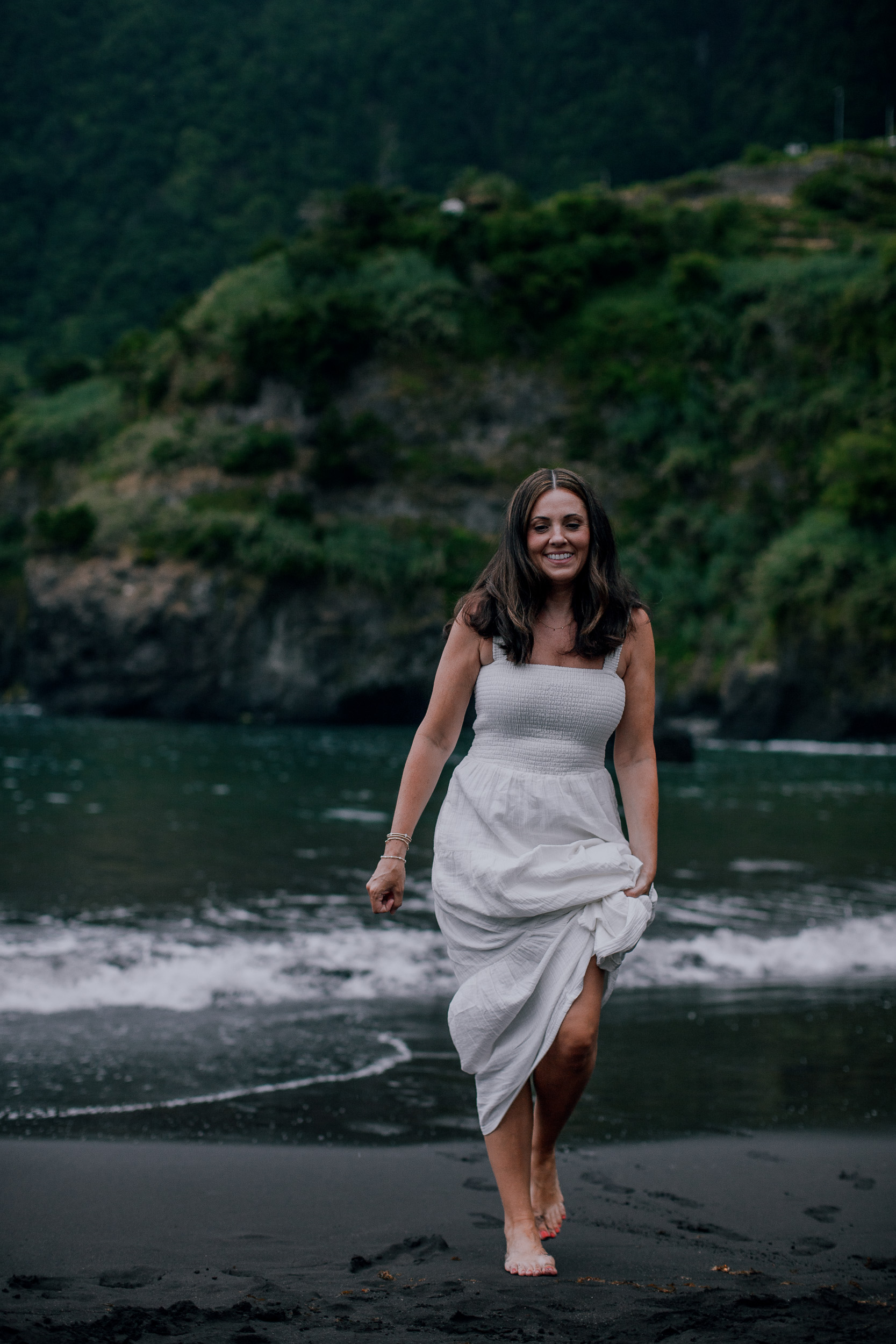
Seixal, August. A cotton dress she could gather in one hand and keep walking.
Short list
What doesn't work here.
- · Glossy polyester and satin. They catch direct sun as a hard white patch and read as plastic on camera.
- · Tight small prints. Fine pinstripe, small check, small polka dot. At a distance they flicker and go muddy.
- · Big logos and slogans. The eye lands on the word and stays there. In two years the logo dates the picture.
- · Neon. It bounces its own colour onto your face, and onto the face of whoever stands next to you.
- · Pure black on the coast at golden hour. It loses all texture and goes flat. In the shaded old town it behaves.
- · Anything you've never worn. A new outfit takes a share of your attention, and it shows in the face.
None of these ruin a session. I've shot good frames through every one of them. They just make my job harder and yours less comfortable.
03
Layers and wind.
Funchal at sea level and Fanal at 1,150 metres are the same island on the same afternoon, and they are nowhere near the same temperature.
The coast
Praia Formosa, Câmara de Lobos, the Funchal seafront. Warm, breezy, one layer is enough most of the year. Evenings in winter get cool once the sun drops behind the ridge.
Up in the laurel
Fanal and the high viewpoints run colder, and the air is often wet even in July. A cardigan or an overshirt up there is not decoration.
Cliff viewpoints
Guindaste, Ponta de São Lourenço, Pico do Arieiro. Real wind. Standing still in it is work.
What 1,150 metres actually feels like.
The forecast on your phone is written for Funchal. Up on the plateau you are usually standing inside the cloud rather than under it, and the air is wet even when it is not raining.
Bring one more layer than you think you need for the drive up. If the session pairs a mountain location with a beach, the difference inside two hours is large: cold and wet at the top, warm and still at sea level forty minutes later.
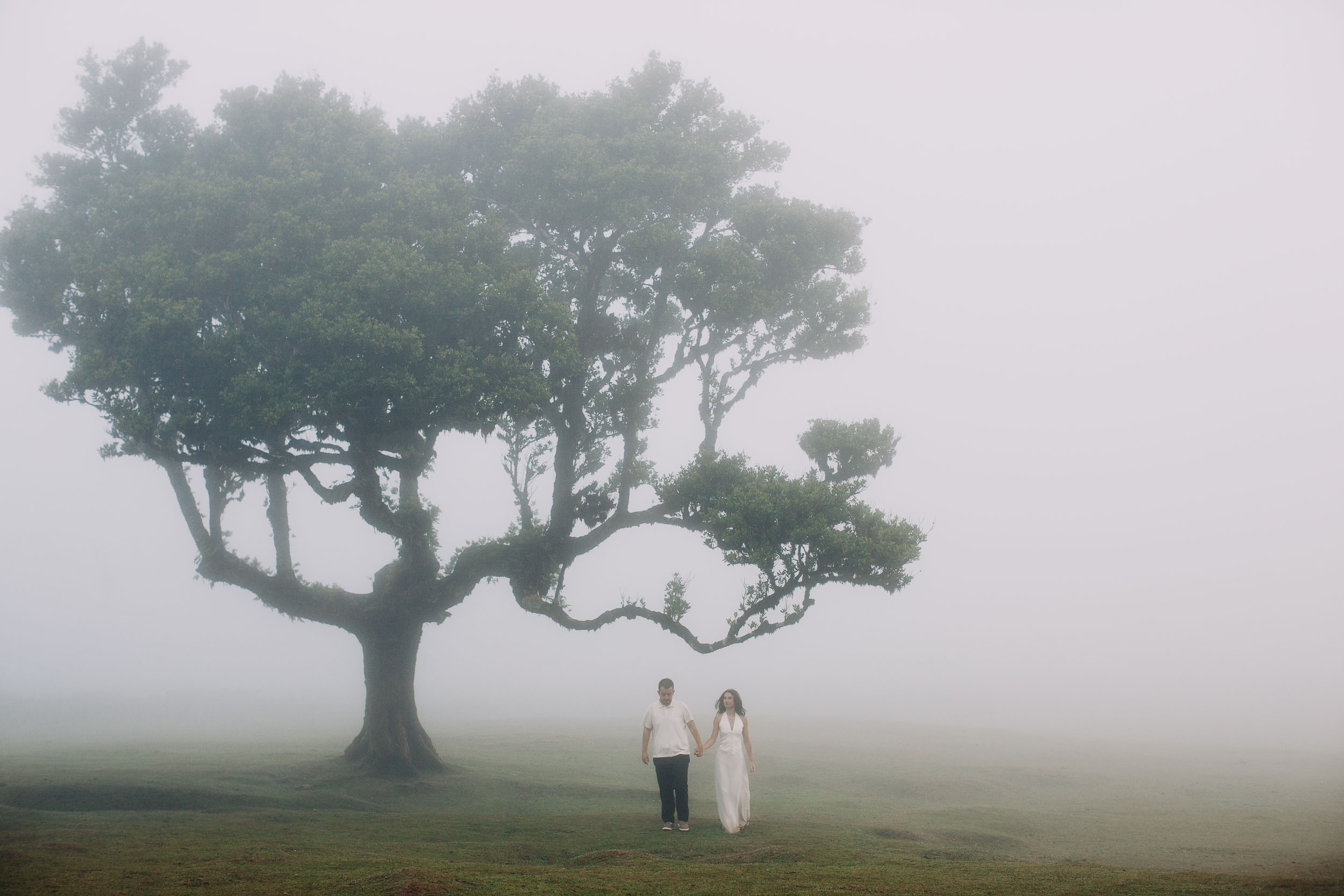
Fanal at six in the evening in September. Visibility about forty metres.
Bring a layer you'd be happy to be photographed in.
A cardigan, a linen overshirt, a wrap, a denim jacket. It comes off for half the session and goes back on for the other half, so it ends up in the pictures either way.
A technical rain shell keeps you warm and looks like a technical rain shell. Bring it for the drive if you like, and bring one nicer layer for the frames.
A jacket handed over at the moment someone gets cold is one of the better things that happens in a session.
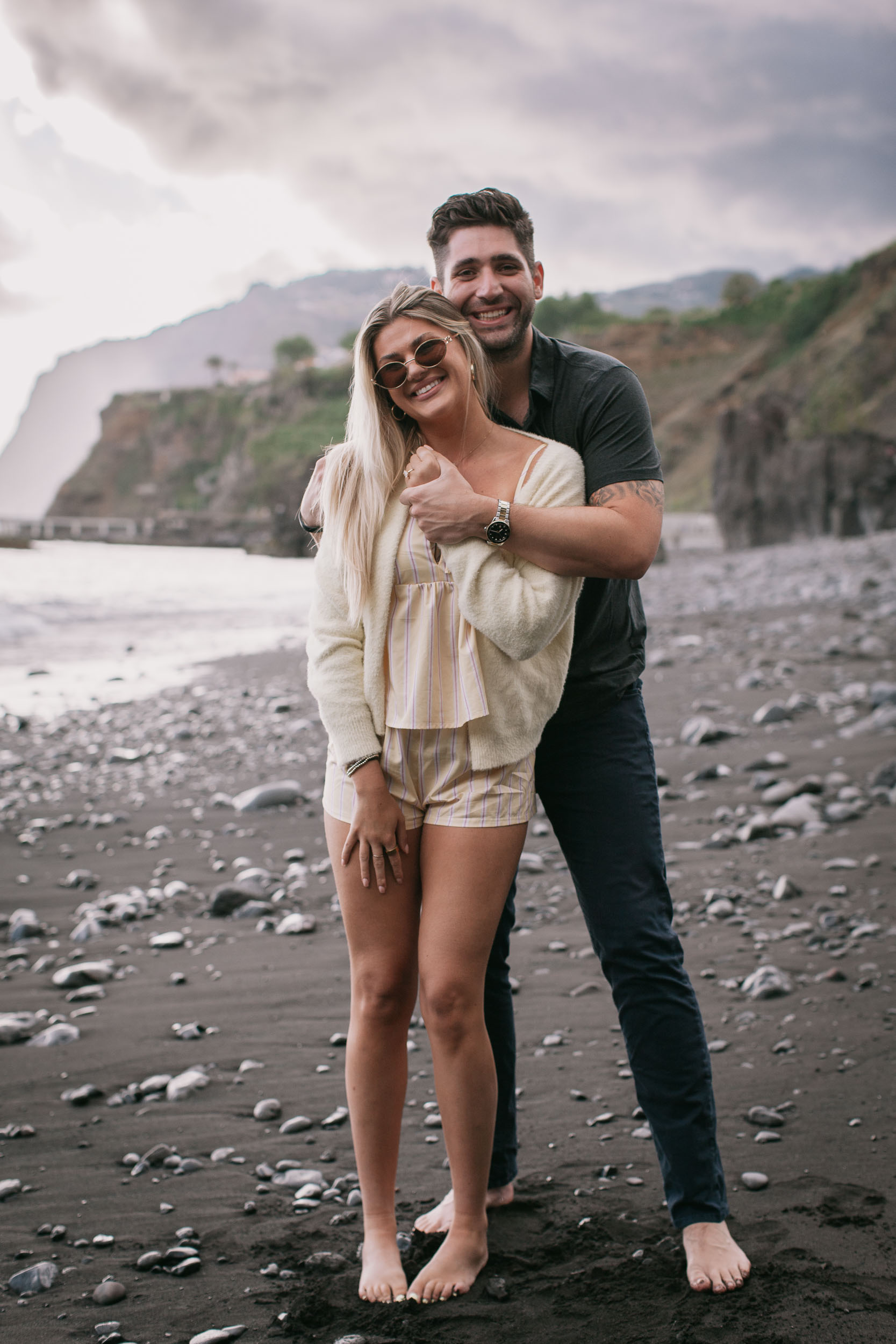
A cream cardigan over a summer outfit. Praia Formosa on a grey May evening.
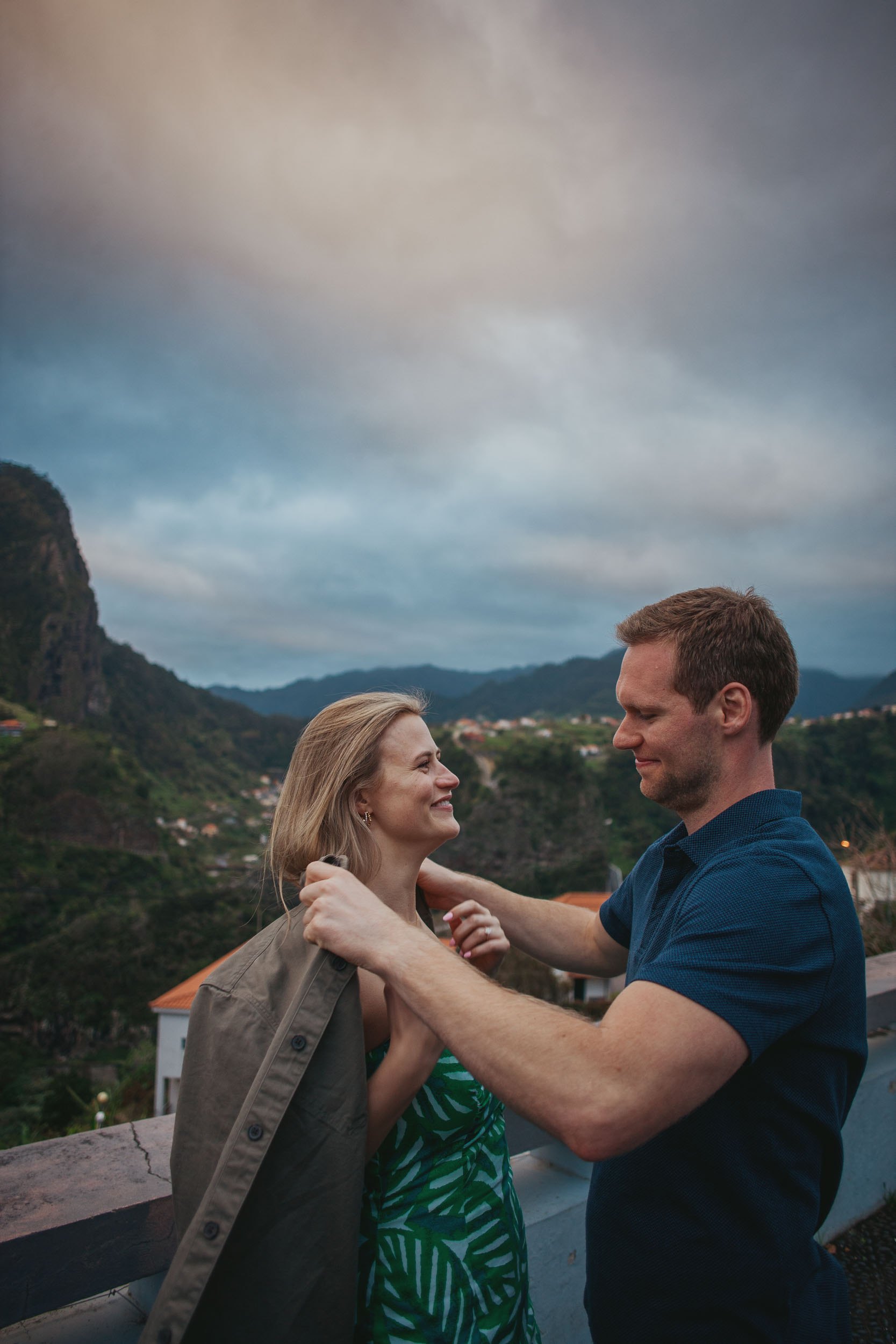
Faial at dusk, temperature dropping. His jacket, her shoulders.
Hair, and what the wind does to it.
Hair tie on the wrist. Always. Long hair in coastal wind goes straight across the face, and there is no way to shoot around that for an hour.
Tie it back and keep the face clear. Or let it go and let the wind be part of the picture.
The one thing that doesn't survive is a style that needs fixing every ninety seconds.
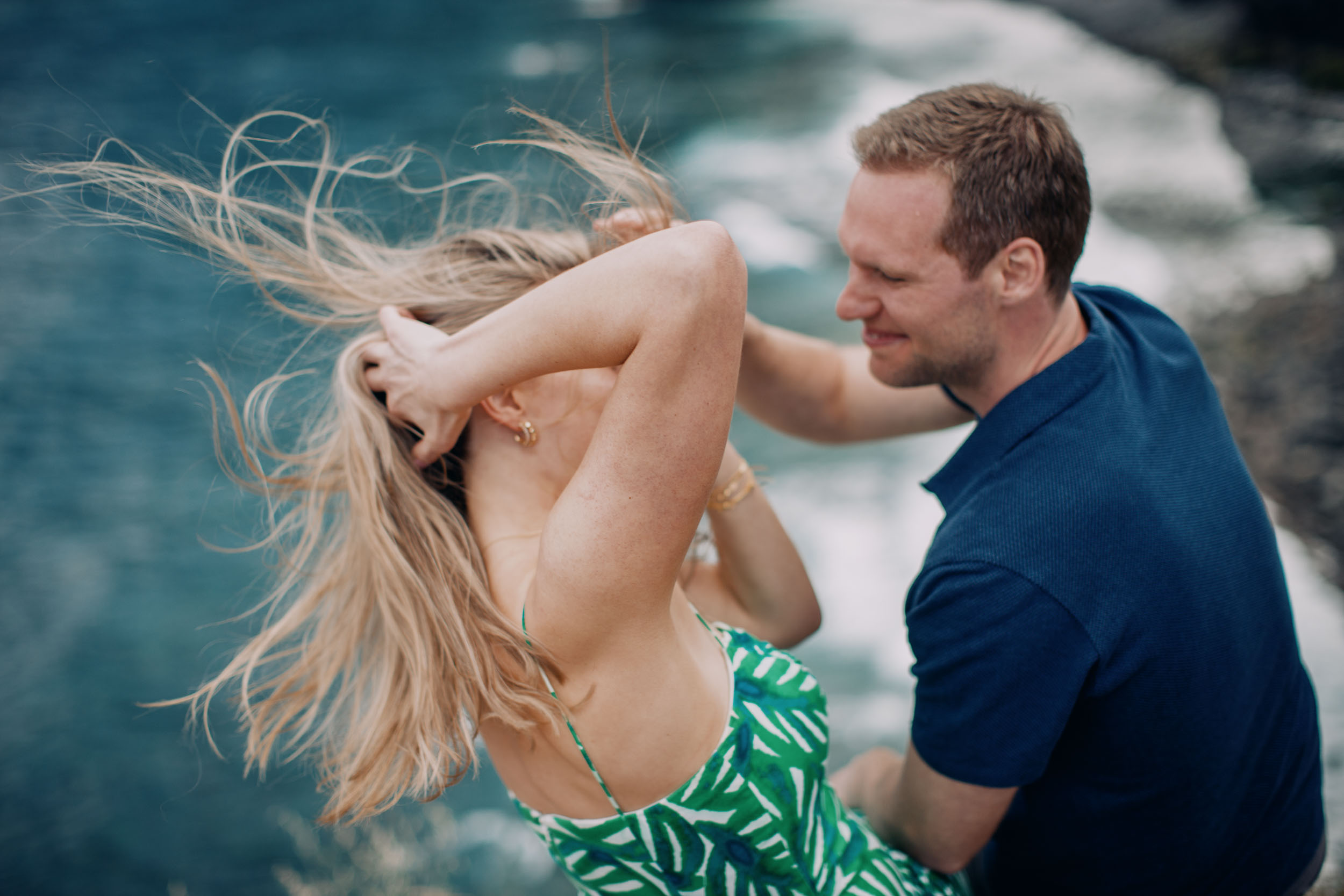
Miradouro do Guindaste in April. This is a normal amount of wind for that spot.
04
Shoes.
The ground here is loose stone, wet sand, mud or polished cobble.
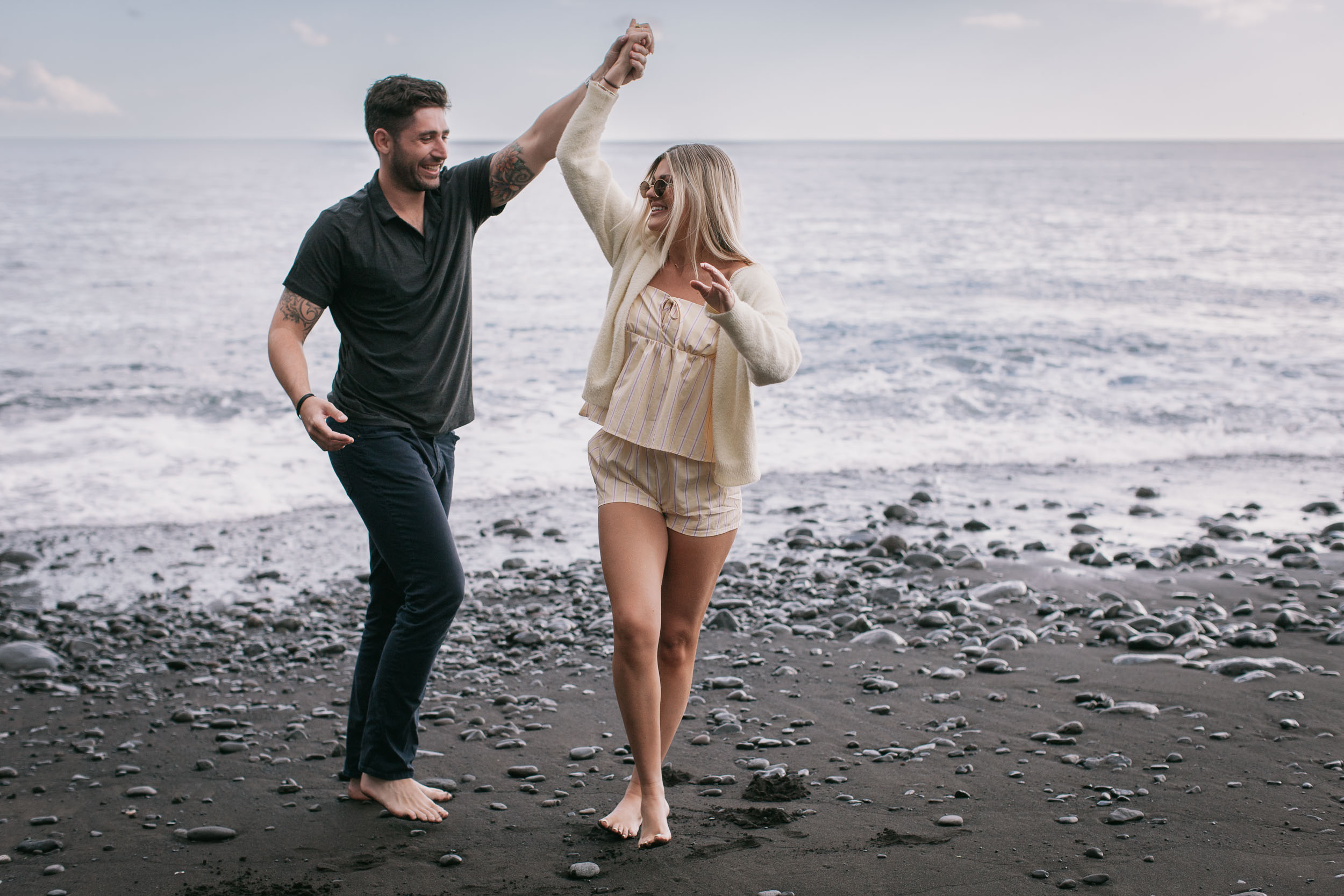
Black sand: barefoot. Shoes stayed in the car.
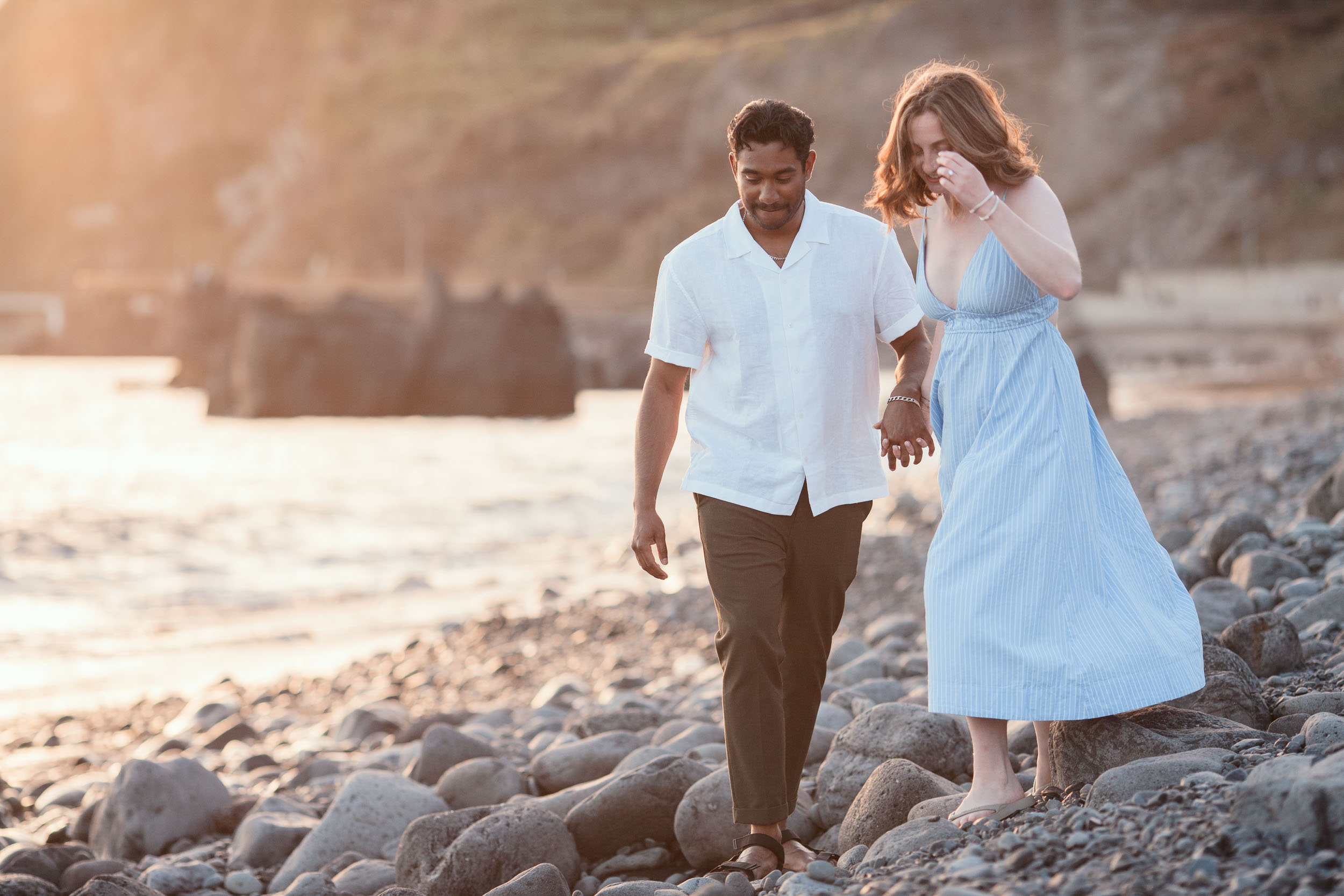
Round lava stones. Flat soles with a strap, and you still watch your feet.
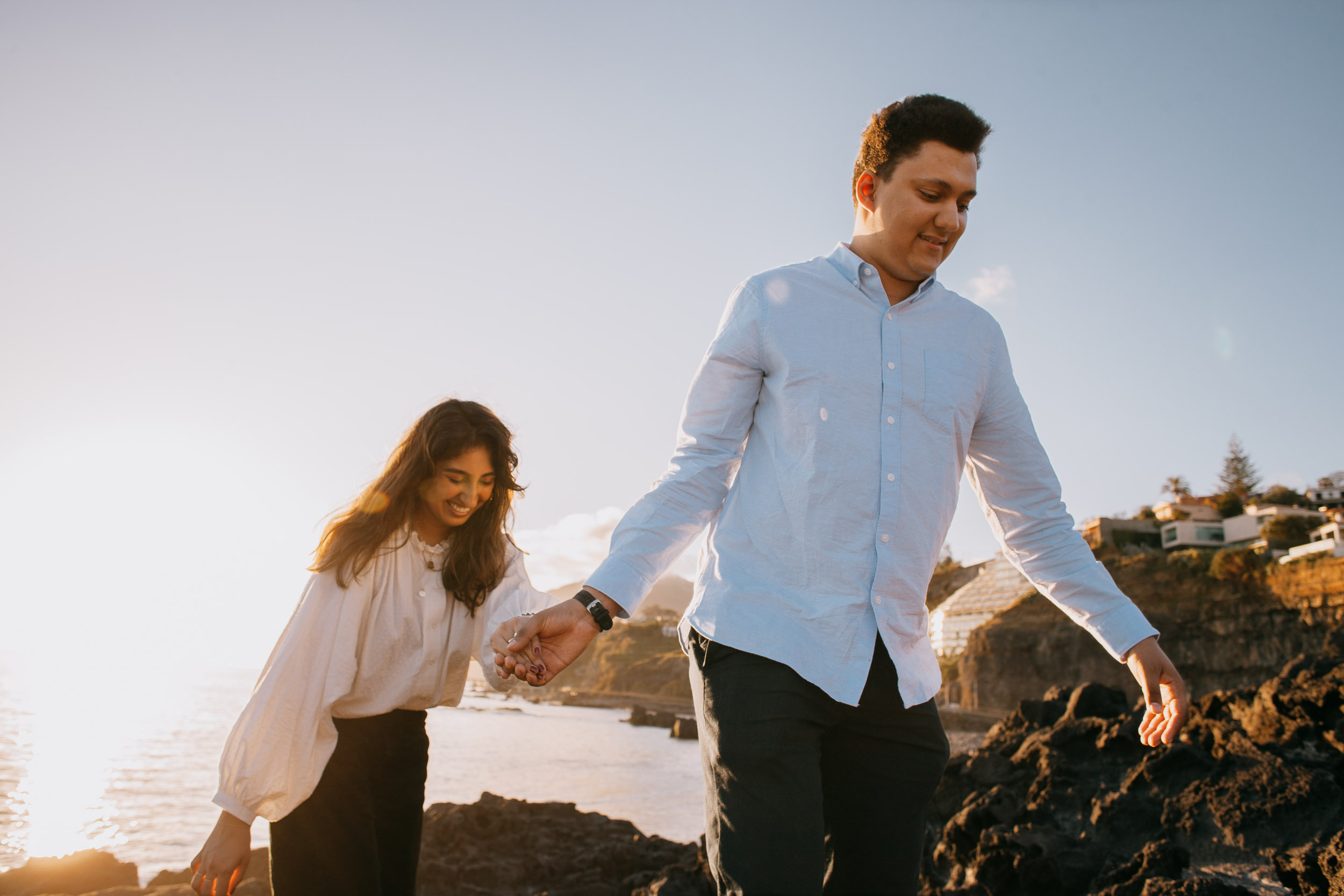
Sharp basalt at Praia Formosa. A hand and a solid sole.
Black sand: barefoot.
Seixal and Praia Formosa sand is fine, cool and gets into every shoe you own. Take them off at the start and leave them with your bag. Bare feet on dark sand also look better than any sandal.
Round lava stones: flat soles with grip.
Most of Praia Formosa is rounded pebbles the size of a fist. Sandals with a heel strap work. Flip-flops slide off the stones.
Fanal and the high meadows: sneakers.
Wet grass, mud, tree roots. Trainers or trail shoes, and accept that they will be dirty. It rains up there on days when it rains nowhere else on the island.
Funchal calçada: the one place heels work.
The old town is laid in polished black and white basalt. It's beautiful and it's slippery when damp. Heels look right here and only here, and I'd still carry them and change on arrival.
Carry the nice pair, walk in the other.
Feet are in maybe one frame in twenty. We put the good shoes on for those and you walk in whatever gets you there. Nothing brand new, ever.
05
Families with kids.
Booking a family session is different from a couples shoot. The rules are simpler and the expectations are lower. Here is what eighteen years of photographing families on islands taught me, Thailand before this one.
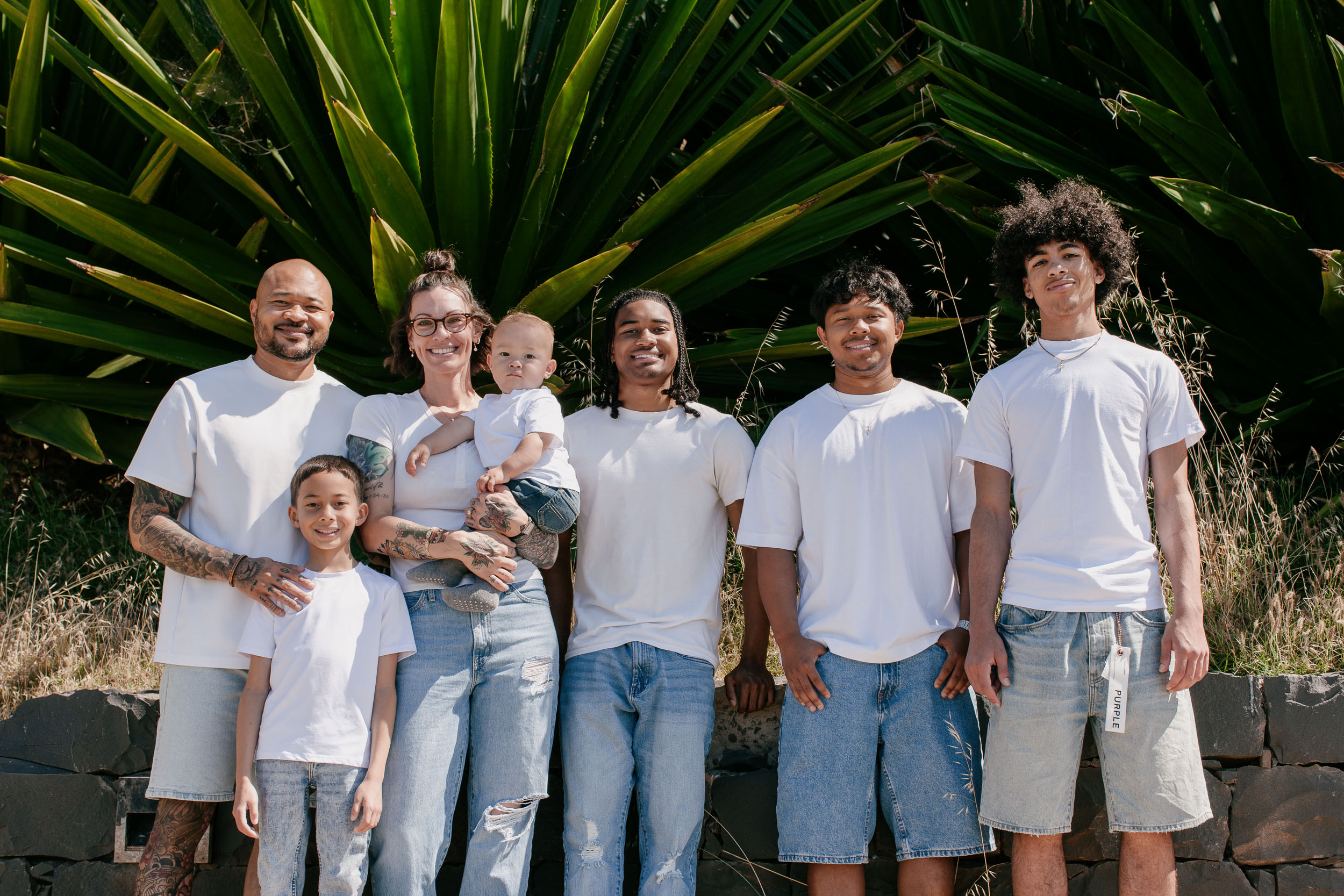
Seven people, white and denim, Praia Formosa. One palette held across a whole family.
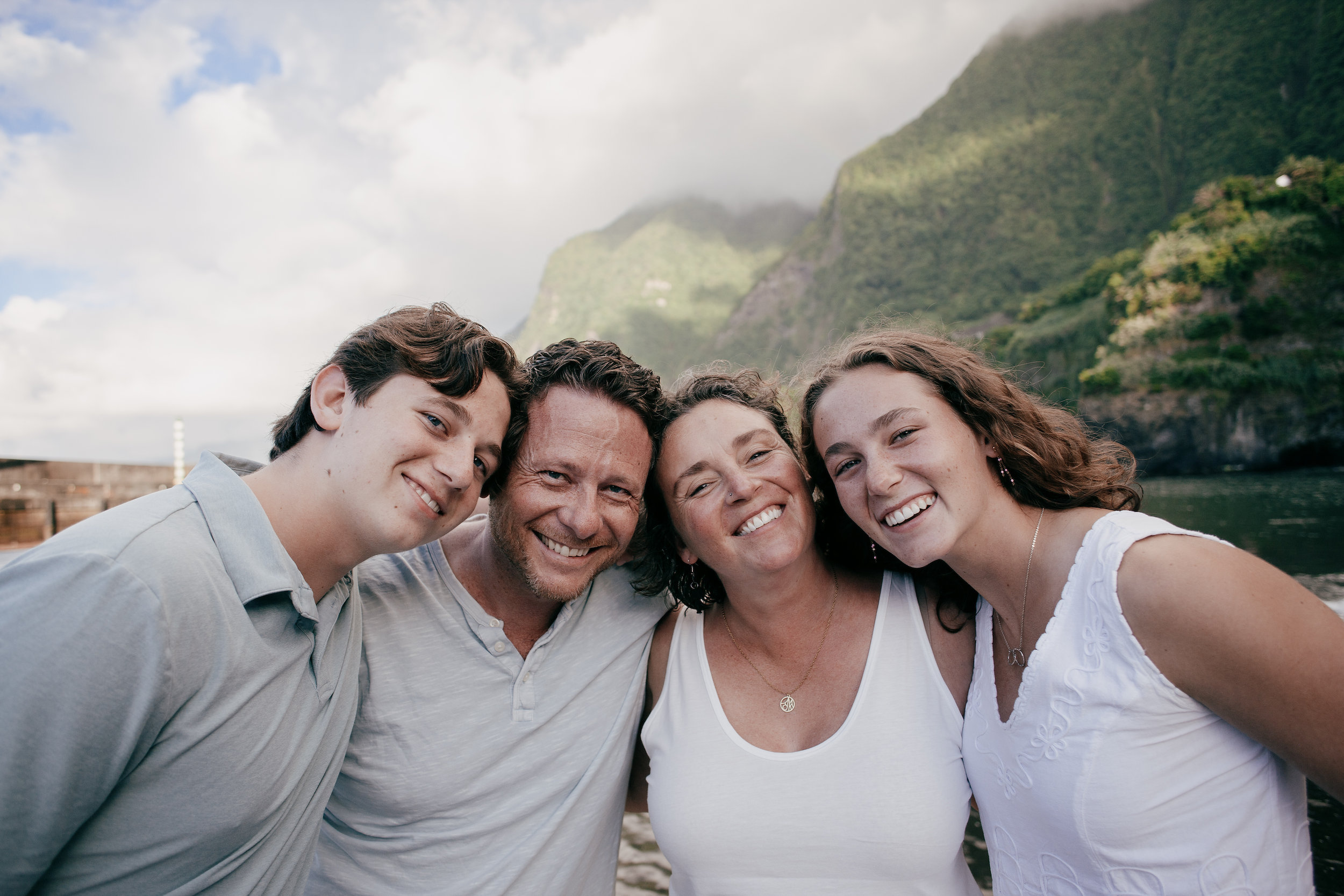
White, pale grey, soft sage at Seixal.
One palette. Up to four colours.
Pick three or four quiet colours. Whites, creams, soft blues, warm beige, soft grey. Give each person a different mix inside that range. Mum in cream, dad in pale blue, kids in white and denim.
Start with the hardest person to dress, usually a teenager or a toddler, and build the palette around them.
Do not coach the kids.
My job is to photograph what is actually happening. The running, the not-listening, the hand on a parent's leg. Please don't ask them to smile. Let them be bored, let them ask to leave. Some of the best frames come in the last five minutes, when everyone has given up performing.
Best time with small kids.
Morning, not evening. First hour after breakfast is the sweet spot.
How long we actually shoot.
With kids under six, plan on forty to sixty active minutes, even if the package is longer on paper. We move at their pace. You will not get more images by pushing.
What to bring for kids.
A small snack, water, one favourite toy. Less stuff means less to tidy out of the frame.
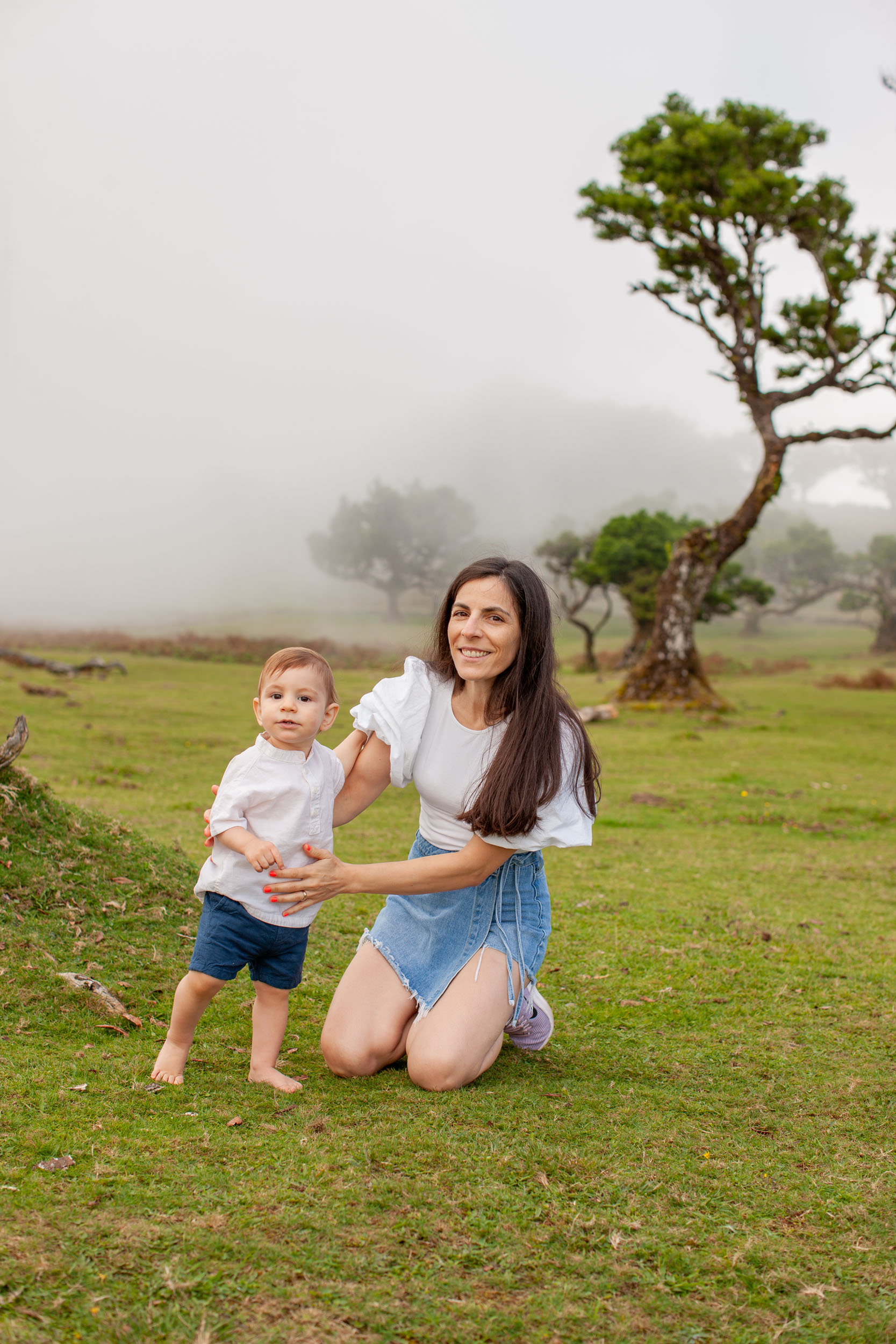
You need to enjoy the moment of your life.
06
When to shoot.
The same location at 11am and at 6pm gives two different photographs.
Midday
Old town, shaded streets.
Cobblestones, painted doors, market hall, cafés in Funchal Old Town. Hard light is unflattering on open ground but good filtered through narrow streets. Works from 11 to 3.
Blue hour
The half hour after the sun goes.
Almost everyone packs up at sunset. The thirty minutes after it are the part I would keep if I could keep only one. The whole sky becomes the light source, shadows disappear, and the lights of the coast road come on across the water.
There is not much light left, so the shutter stays open longer and records movement. I ask people to run.
It has one consequence for booking. A one hour session either ends when this window starts or misses the golden light before it. The longer version is here.
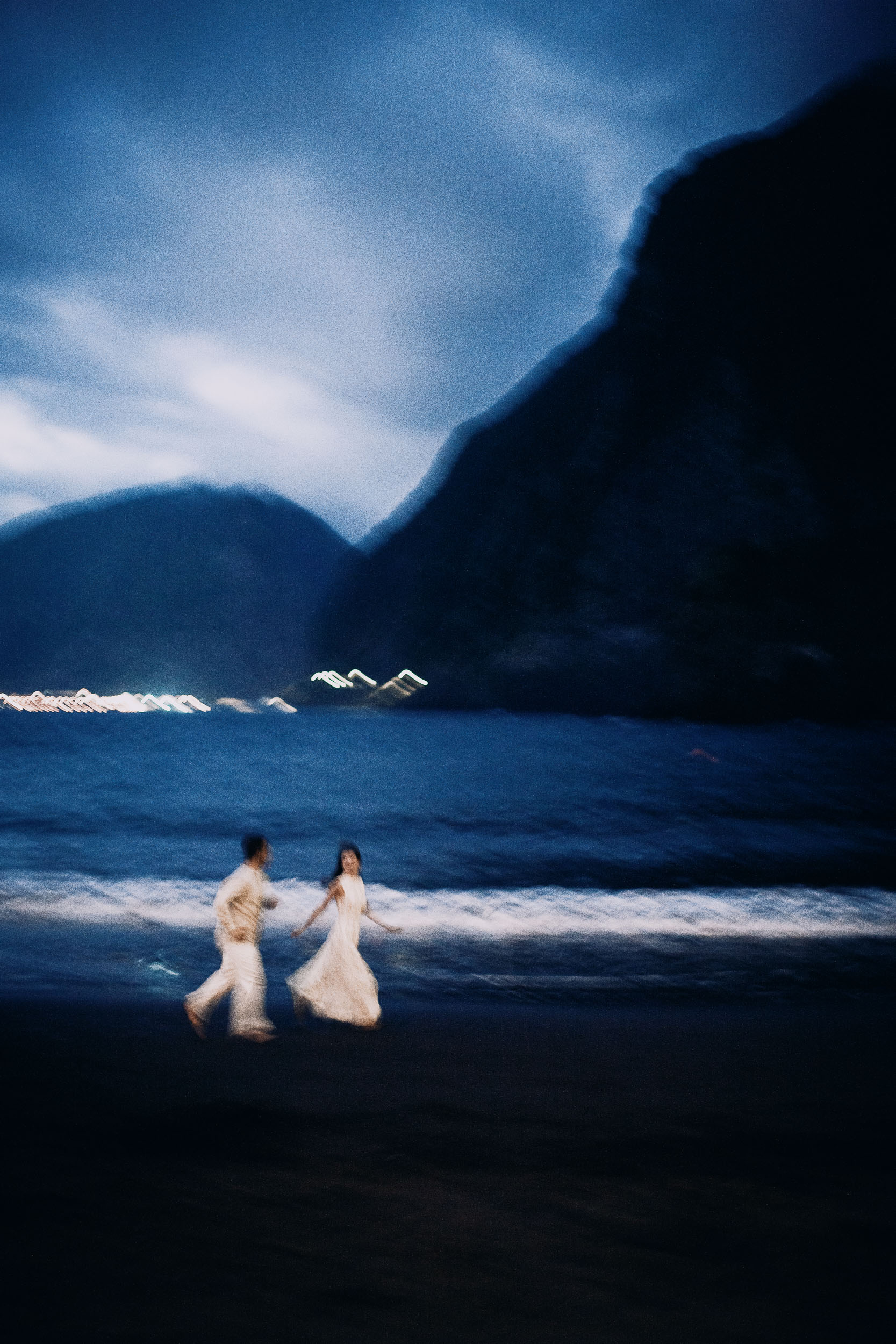
Seixal in September, about twenty minutes after a 20:33 sunset.
Fanal is the exception, and it goes against what most guides say. In my experience the fog at Fanal is often there in the evening as well, and there are fewer people. The guided groups come in the morning: an evening that far from Funchal does not suit their working day. So I shoot Fanal late in the day. Nobody can promise fog at any hour, but the quiet part of the day here is the evening one.
We always agree on the start time individually, depending on the goals of the shoot and your wishes. People often pick a rounder time and land forty minutes before sunset, by which point the good light has already gone over the ridge.
Places on a west-facing slope lose the sun earlier than the printed sunset time. Santa Catarina Park is one of them. I check the specific spot against your date and suggest a start time from that.
07
What to bring.
Two outfits.
One safer, one more adventurous. I help you pick which one on the day, based on the light and where we're standing.
A layer.
Cardigan, linen overshirt, or wrap. Necessary at any viewpoint above Funchal, and it reads well in the pictures.
Shoes you can walk in.
Plus the nicer pair in a bag if you want them. Section four has the detail for each kind of ground.
A hair tie on the wrist.
Always. You will need it.
A towel or wet wipes.
Black sand sticks to wet feet and travels into the car.
Water.
Especially for family sessions with kids.
08
On the day.
If the weather turns.
Light rain and heavy dark cloud are not a problem. Some of my favourite frames come out of that weather, and Fanal is better in it. If you're fine with a jacket and wet hair, we shoot.
If the weather isn't right, we move the session to another day, free of charge.
The morning of.
Eat something. Drink water. Don't schedule anything demanding in the hour before we meet.
If you're doing makeup, less is more on camera, especially outdoors. Matte foundation photographs better than anything dewy in strong light. Skip heavy contour. Hair down and natural reads better than styled.
If you feel nervous in the first ten minutes, that is normal. Everyone does. It passes. We start with easy frames.
I have seen a carefully chosen outfit spoil a session because the person wearing it thought about it for the whole hour. Pick the thing that feels like you. The rest is my job.
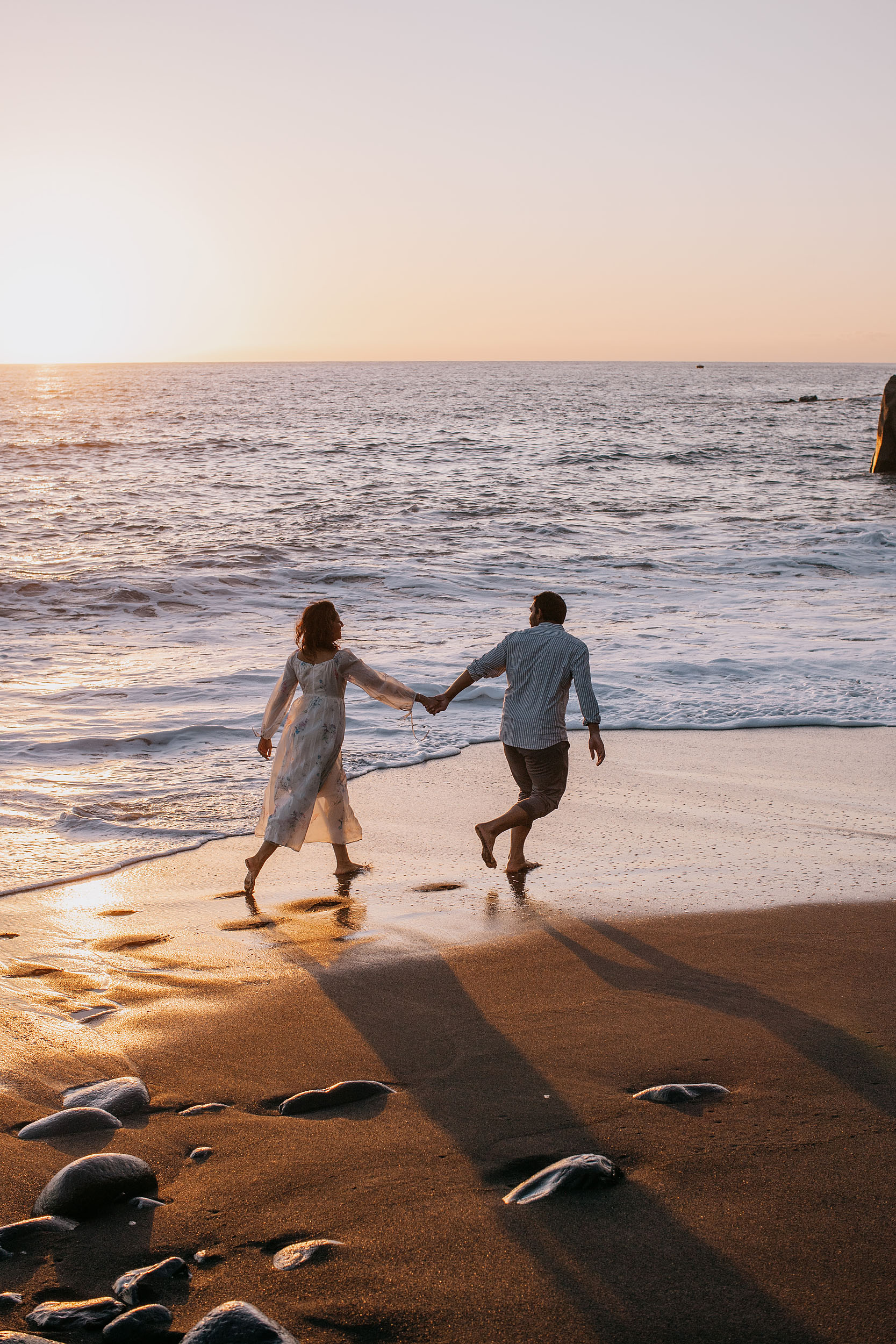
Show up. Trust the light. I'll do the rest.
Next step.
Already booked
Send me your questions.
Outfits, timing, logistics. Anything that is not answered above. I usually reply within the hour.
Ask on WhatsAppNot booked yet
See packages and pricing.
Four options from a short session to a full day on the island.
Browse sessions